
What you'll learn
"Am I really supposed to sit next to him while he does all his homework?" "Am I really supposed to go through her backpack checklist with her every single morning?" Underneath both questions is the same worry: if I help this much, am I making my child dependent on me? This episode answers it with the Expectations pillar of Precision Parenting™ and the tool that puts it into practice: scaffolding.
- Jill's three expectation checks: what's realistic for the age, what your child needs (not what other kids are doing), and pausing to celebrate before adding the next skill
- Why a skill that "disappears" on a Friday morning didn't actually go anywhere (acquisition vs. performance)
- What scaffolding really means, and why the right support now is the most direct path to independence
- Zero, partial, and maximal support, using one backpack as the example
- The green light for fading support: consistent success, then one layer at a time
- Two real case studies from our community: a 12-year-old's homework and an elementary schooler's backpack checklist
Key concepts
Terms from this episode, explained simply.
Realistic expectations
Not every struggle is about being outside the box. Sometimes a five-year-old isn't cleaning their room well because they're five. Start with what's realistic for the age, then ask what your child needs right now.
Stop adding expectations
When your child picks up a new skill, celebrate it and stay there for a while. Pushing the ball down the field to the next thing right away keeps everyone feeling behind.
Acquisition vs. performance
Acquisition means the skill exists. Performance means your child can use it reliably across settings, times of day, and nervous system states. For many kids, acquisition comes months before performance.
Draining the tank
A child who has held it together all day at school may come home with an empty tank of regulation. The same task they did easily in the morning can feel impossible at 4 p.m.
Scaffolding
Like scaffolding on a building, it's temporary support. Give your child exactly enough help to succeed at something they can't yet do on their own, then pull it back gradually as their capacity grows.
Zero, partial, and maximal support
"Go pack your backpack" is zero. Gathering the folder, lunchbox, water bottle, and sweatshirt together is maximal. A written whiteboard list they check off is partial. The right level can change by the day and the time of day.
Never in the moment of panic
In the hard moment, just help your child. Plan scaffolding later, in the shower, on the drive, while you cook, by noticing which times of day and tasks are hardest.
Fade one layer at a time
The signal to pull back is a genuine pattern of success, not one good day. Remove one small piece, watch what happens, and add support back without judgment if it's too much.
Say it out loud
Maximal support isn't doing it for them while they watch TV. Do it together and narrate each step ("I'm pulling out your folder, now your planner") so your child learns the sequence.
Refuel first
Before scaffolding the task, check the nervous system. Heavy work, movement, or proprioceptive input (like Lily's daughter running around the pool 10 times) can refill the tank so the skill is reachable again.
Show notes
Episode notes & resources.
Episode 3 takes on the question parents ask Kinspire most: how much support should I be giving my child? Jennifer, Lily, and Jill connect it to the Expectations pillar of Precision Parenting™ and walk through scaffolding: the just-right support that helps your child succeed today while building the skills for more independence tomorrow.
You'll hear why a skill can seem to vanish on a hard day, how to scaffold without doing everything for your child, and how to know when it's time to add support, hold steady, or begin pulling it back. Then Lily and Jill coach through two real questions from our community: a 12-year-old with ADHD and sound sensitivity who can't get started on homework, and an elementary schooler with autism and ADHD who walks right past her backpack checklist.
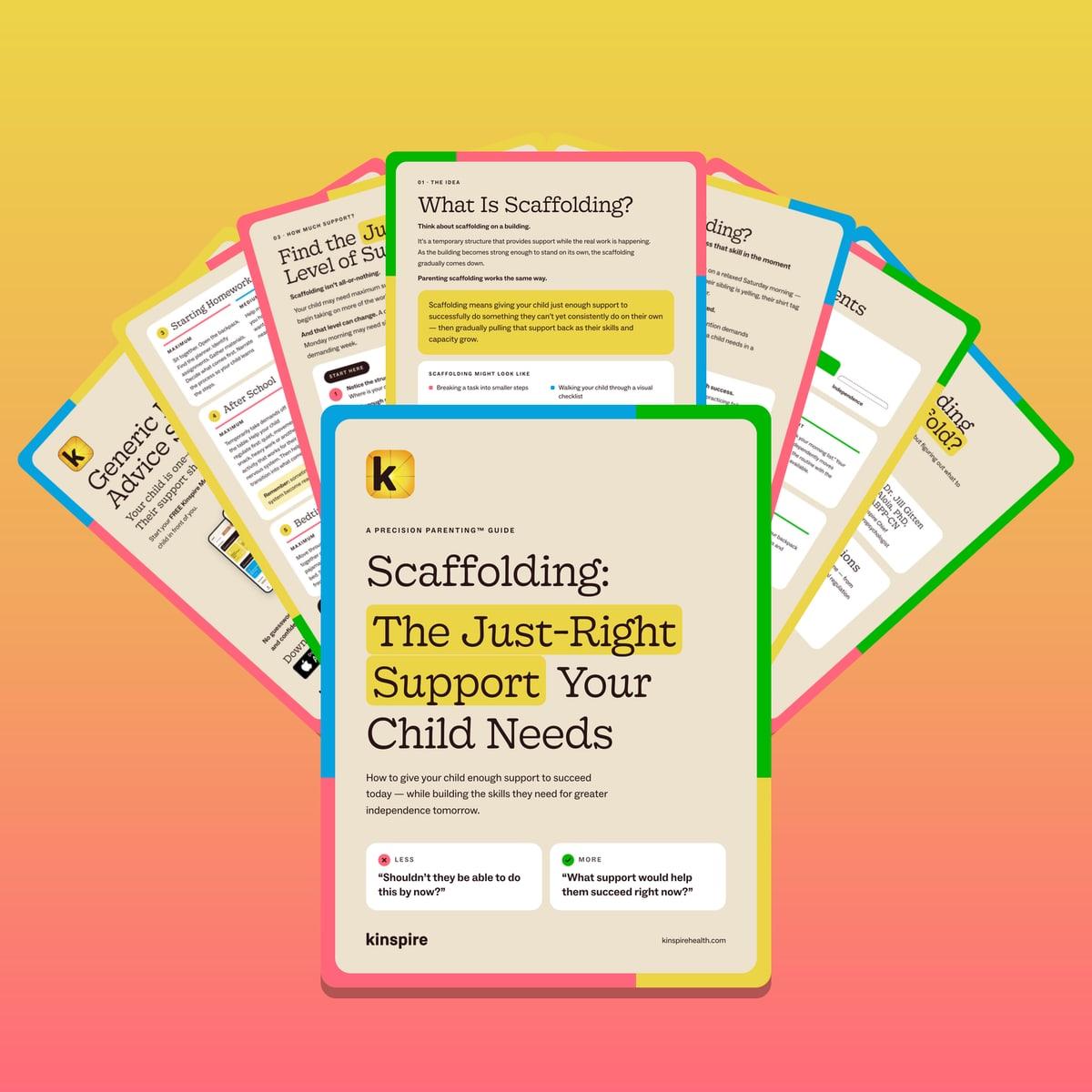
Download the Scaffolding Parent Guide below to put the episode into practice at home. Next week: meltdowns, regulation, and what's actually happening in your child's brain.
Try this this week
Pick the hardest moment in your child's day. Before it happens, ask Lily's question: what does my child's nervous system need to have the best chance of succeeding right now? Ten extra minutes, a different spot, movement first, or just sitting beside them. Then try Jill's parenting-side step: break that task down into one more step than you usually would.
Instead of asking:
“Why can't they do this by now?”
Try:
“What does my child need to be successful in this moment?”
Episode outline
- The question from 100+ hours of support groups: how much should I be helping?
- Rightsizing expectations: age, comparison, and celebrating before adding more
- Having a skill vs. accessing it: acquisition and performance
- Draining the tank: why skills slip after a long school day
- What scaffolding is, and why it leads to independence
- Zero, partial, and maximal support: the backpack example
- Where to start (never in the moment of panic)
- Green lights for fading support, one layer at a time
- Case study: a 12-year-old with ADHD and sound sensitivity, and homework
- Refuel the tank first: movement, heavy work, and running around the pool
- Case study: an elementary schooler with autism and ADHD, and the backpack checklist
- A permission slip for trial and error, and normalizing checklists
- Try this week: plan for the hardest moment · break it into one more step
Mentioned in this episode
- Download the Scaffolding Parent Guide
- Episode 2 — Same Meltdown. Different Reason.
- Episode 1 — You're Not Failing. You're Under-Supported.
- Precision Parenting™ on Kinspire
- Live group sessions with Kinspire experts
- Start your free Kinspire membership
- Next: Episode 4 — After-School Meltdowns: Why Kids Fall Apart at Home (and What Helps)
About the hosts
Lily Baiser, MS, OTR/L is Kinspire's Co-Founder and Chief Clinical Officer — a pediatric occupational therapist with deep expertise in regulation and sensory processing. Jill Gitten Aloia, PhD, ABPP-CN is Kinspire's Chief Neuropsychologist, with decades of experience connecting behavior, executive function, and the developing brain. Jennifer Mingucci hosts Built For Your Family™.
Transcript
Full episode transcript.
Jennifer
Welcome to Built for Your Family, an original podcast by Kinspire. I'm Jennifer Mingucci, and I have the privilege of leading our incredible community of parents raising outside-the-box kids. These are parents navigating developmental differences, delays, diagnoses like autism, ADHD, sensory processing challenges, learning differences, or sometimes just the feeling that traditional parenting advice doesn't quite fit their child. And if that's your story, you belong here with support built for your family.
Jennifer
This past year, I've had the privilege of hosting more than 100 hours of support groups, office hours, and workshops for our incredible community of parents raising outside-the-box kids. And no matter what the topic was, one question kept coming up again and again: how much support should I be giving to my child? We heard it in our homework session when one mom asked, "Am I really supposed to sit next to him while he does all his homework?" We heard it in our ADHD support group, "Am I really supposed to go through her backpack checklist with her every single morning?" Underneath both questions is the same worry: if I help this much, am I doing too much? Am I making my child dependent on me? Shouldn't they be able to do this on their own by now? And our answer goes back to one of the core pillars of Precision Parenting, expectations, and a tool that helps us put those expectations into practice: scaffolding. In today's episode, we are gonna break down how to rightsize your expectations for the child in front of you, what scaffolding actually is, how to use it at home without doing everything for your child, and how to know when it's time to add support, hold steady, or begin pulling that support back. And we'll make it real with examples drawn from the questions we hear every week from families inside our community. Let's jump in.
Jennifer
Dr. Jill, I would love to start with expectations. For parents listening, how can they reframe what they expect from their child? I feel like that is, like, the big thing. Parents are like, "Shouldn't they be doing this by themselves?" What are your thoughts?
Dr. Jill
Well, I think three thoughts come to mind. The first is that it's helpful to think about realistic expectations for that age. One of the problems I think we run into when we have outside-the-box kids is that we tend to blame everything on the fact that they're outside the box in some way. We might think, "Oh, they're not cleaning their room because they struggle with executive functions," when actually it might be they're not cleaning their room well because they're five years old. We do hear that a lot from parents, where they'll ask us questions like, "Shouldn't my five-year-old be able to clean up their room when I ask them to?" And instead, your five-year-old might be able to put the toys back in the bucket. You ask them to do that one task, but if you give them something broad, that's not an appropriate expectation for that age. That's the first thing: what is realistic for this age, whether or not my child struggles or has a diagnosis?
Dr. Jill
The second thing that comes to mind is that it's important to let the pressures go from everybody else and really think about your kid. Most of us do comparisons with other people. "Well, you know, that middle schooler is completely managing his or her homework on their own. Why can't my middle schooler?" And that's the second piece with expectations: you have to focus on where your child is and what supports they need right now to be successful. They're not gonna need those forever, but what do they need right now?
Dr. Jill
And then the third thought that comes to mind around all of this is that we just need to be careful that we're not constantly adding on expectations. We tend to do this. We find a skill that our child's not doing, we teach them that skill, and then we think, "Oh, well now they should be doing the next thing, and what about the next thing?" And we're constantly pushing the ball down the field, instead of saying, "Wow, that's great. They just picked up this skill. Let's celebrate that. Let's sit there for a while and not worry about the next skill right away." So lots of things to think about with expectations, but really first starting with: how old is my child? What should they be doing at that age? And what can they be doing themselves, not in comparison to others?
Jennifer
I feel like we hear from parents in our community all the time who are like, "I would love my kindergartner to be able to clean up after dinner." And I think you made the whole room's shoulders drop when you said, "Well, no kindergartner is gonna clean up their plate every single time in the exact way." Lily, I would love to know from you: how do you think about the difference between a child being capable of doing a skill in general, and then being able to access that skill in a specific moment? Something that comes up all the time is a parent who says, "They can pack their backpack. They remember everything. Most mornings everything is fine, and then suddenly Friday morning they don't know where their backpack is, they've never seen their folder, they can't access that skill." What are your thoughts on being able to do it and being able to do it in the moment?
Lily
Yeah, I think it's so important to talk about, 'cause so many parents experience this every single day. There is a huge difference between a child having a skill and a child being able to use that skill in a given moment, and the gap between those two things almost always comes down to their nervous system state. So for a simple example, a child might be able to tie their shoes perfectly when they're calm, they're rested, it's the weekend, they're sitting at the kitchen table. And that same child might not be able to tie their shoes at all when they're rushed, when they're dysregulated and trying to get out the door, their shirt tag is bothering them, and their sibling is loud. Did that skill disappear? No, but their ability to access it did.
Jennifer
Okay. Wait. We gotta pause. We have to pause. One, I really appreciate you saying that the skill did not go away, because I do think parents in the trenches are like, "We cannot be back here." They're thinking it's like we've regressed. It's gone forever. So you're saying, Lily, not gone forever?
Lily
Not at all. No.
Jennifer
Okay. Continue. Sorry, that really took me out.
Lily
It really just means that their nervous system is not in a state to perform that skill. So acquisition means the skill exists. We have the skill. But performance means the child can actually deploy it reliably across different environments, and potentially different times of day and different nervous system states. For a lot of our kids, acquisition comes way before performance, sometimes by months, sometimes longer. And expecting performance before a child is there is one of the most common sources of frustration that we see in families. Because from the outside it looks like the child is just being inconsistent or difficult or not trying, being lazy. But what's actually happening is that their nervous system is telling you something really important about what they need. So what should parents watch for? I think it's the pattern. Does your child do better with a skill when they're more regulated, at certain times of day, in certain environments, even after certain inputs? If the answer is yes, and for most of our kids it actually is, then that's your data. It's not inconsistency. The nervous system is truly just communicating what it can do in the moment.
Jennifer
Dr. Jill, what are some things you hear from parents that are impacting their child's ability to perform a skill? What could be contributing?
Dr. Jill
Exhaustion. Holding it together all day. So when your child struggles, for example, with executive functions or attention, and they've been paying attention all day in school, and then they come home and you ask them to do the same task that they were able to do in the morning, when they were well-rested, they slept well, they had eaten a nice breakfast, they were calm, maybe excited about going to school and seeing friends. And instead, now they're completely drained. We talk about it like draining their tank of regulation. It's empty at that point, and so they're not able to do the skill anymore.
Jennifer
Lily, I know that we talk at Kinspire a lot about scaffolding, and I know when parents hear that, they think it simply means them helping their child more. I would love if you could go into how you look at scaffolding. What makes it different from stepping in and doing everything for your child?
Lily
I think scaffolding is one of those words that sounds really clinical and complicated, but it's actually a really simple, intuitive idea. It comes from construction, right? We all know what scaffolding is on a building. It's a temporary framework you build around a structure while the real work is happening. It holds it up. And when the structure can hold itself, the scaffolding comes down. It was never meant to be permanent; it was always just temporary. So in child development, scaffolding means giving a child exactly enough support to experience success at something they can't yet do on their own, and then intentionally and gradually pulling that support back as their capacity grows.
Lily
So really, you need to meet your child where they're at and then support them from that point. And there is a difference between doing everything for them and scaffolding. You don't wanna remove the challenge entirely, because then they're not practicing anything. You don't wanna perform the task on their behalf. You want to be helpful in the moment based on what their skill level is. Scaffolding is supposed to keep the child in the task, and you're just changing the conditions around that work so it's actually possible for them to be successful. As an example, maybe you're breaking something into smaller parts. Maybe you're sitting next to them. Maybe you're giving a physical prompt or a visual cue. And maybe it's just your regulating presence helping them regulate in the moment so they can actually access their skills. But you really want your child to still be climbing and still be reaching those successes. You just need to make sure you're not doing too much. And another piece that parents are really worried about is that when they scaffold, they might be taking away some of their child's independence. But actually, it's the most direct path to independence, because it lets the child feel success, and they can repeatedly feel that success, and that's really what the brain needs to build that skill.
Jennifer
Okay, well, one, I feel immediate relief when you remind me that this is temporary, and that this kind of support is actually gonna give me what I know every parent wants: to set their child up for success and independence. By giving that just-right amount of support, you are actually on the pathway to independence, not keeping your child dependent on you. I feel like that is so critical. Dr. Jill, I would love if you could talk specifically about executive functioning. How does this kind of temporary support actually build up those very critical EF skills? What is happening when we give a child enough support to be successful today while still building towards independence? How is that all actually gonna work?
Dr. Jill
When you're scaffolding, one of the things that you're taking away is the feeling of complete overwhelm. If you ask a child to do something and they don't know how to plan, how to organize that task, how to break it down, how to start that task, then you get the meltdown. That's what we're avoiding by putting the scaffolding in place. And the scaffolding is really figuring out, like Lily said, that just-right amount of support that your child needs to be able to do the task. Different kids need different amounts of scaffolding. It's not gonna be consistent across kids.
Dr. Jill
To take some executive function examples: say you're asking your child to pack their backpack in the morning, and you say to them, "Go pack your backpack." That's zero scaffolding. You're just giving them the task and expecting them to do it on their own. Maximal scaffolding, and again, picture that construction scaffolding all the way up the side of the building, might be that you're saying, with them, "Okay, we have to do four things when we pack the backpack. We have to get your homework folder, your lunchbox, your water bottle, and your sweatshirt. Let's go get those things together. Let's put them in your backpack." That would be the most support. You're sort of hand-holding, and that's for the child who needs that level of support, and there are kids who do. But other kids might need maybe half that amount of support. So you're giving them a list, perhaps a written list because they struggle with their working memory, holding information in mind. You give them a little whiteboard, and you say, "All right, time to pack your backpack," and it's written on there: water bottle, homework folder, lunchbox, and sweatshirt. And they can check them off. That's partial scaffolding.
Dr. Jill
And across time you can back that scaffolding up. So what does that look like? I think that's a common question parents have: how do I know what to do? Am I gonna stay here forever? So you give it a try. First you're walking around doing it with them, and then you might say to your child, "Hey, let's try: you can go gather these things on your own," and you put them in writing. Maybe you have the kind of kid who's highly distracted, so you give them that list in writing, they put that list down, and nothing gets packed. Well, that's not gonna work, so you know you need a little bit more support still. Or your kid does well with that level of support. They're able to do it with all those things written down, so you can now go down to that level of support. So it's really testing it out, and if you see that they can't do it with the level of support you're trying, then you go back up.
Dr. Jill
And there's another key piece of information here that's really important: the level of scaffolding can change depending on the day and the time of day. If that child's really worn out at the end of the day, they might need more scaffolding than they needed in the morning. Or maybe you're on vacation and they're out of sorts because they don't have their routine. Maybe they need more scaffolding. So as parents, we need to think about being flexible too, and how much support our child needs at any one time.
Jennifer
Well, this is, like, the panic. You're talking and I'm like, "Oh, dear." I am thinking of all of our parents going through the times of day where they're like, "I am at war with my kid. At this specific time of day they're totally melting down. I'm forcing, forcing, forcing. Do I need to consider scaffolding?" And where I'm panicked is: how do I know where to start my experiment, giving enough without giving too much? I would love to hear from both of you. Dr. Jill, jump in first. If I'm panicked about a time of day and I'm like, "I need to be scaffolding here," what could I do to start?
Dr. Jill
Well, my first piece of advice is to never do anything in the moment of panic. In that moment, just help your kid. That's fine. You're not gonna be stuck there forever helping your kid. And then when you have a free moment, whether you're standing in the shower, driving to work, or cooking dinner, think about that time of day. What is most difficult for my child? Is it a certain time of day that's difficult? Is it certain tasks? Just take a minute or two to think about what they're struggling with. If you notice, for example, the end of school is always a rough time of day for your child, then that's a time you can think, "You know what? I'm just gonna put a few more supports in place at the end of the day." Rather than saying, "Oh, well, they're really good at packing their backpack in the morning, so they should..." We don't like the term should. "...they should be able to remember to pull out their homework folder and their lunchbox at the end of the day." Absolutely not, not if you have a kid who's really dysregulated and worn out by the end of the school day. That's a time you might wanna support them. Focus on the fact that they're doing things independently in the morning, and add a little bit more support in the afternoon.
Jennifer
Lily, I would love to know: how do I know if I'm giving too much support? And what are the green lights that tell me I could actually start removing the scaffolding?
Lily
Yeah. So I think the signal to start fading your support is your child being consistently successful. Not success on good days, not occasional success, but a genuine pattern of a child doing a thing reliably with the current level of support. When you're seeing that, the nervous system is telling you that they're ready for the next step. And when you fade one layer at a time, just one, you can assess how your child is doing. Are you seeing progress? Did you pull back too fast? Are they feeling overwhelmed? It's really important to not pull back too fast, because then it feels like all of the effort you've made goes out the window, and everybody gets a little discouraged because now everybody's overwhelmed again. It's just important to take it slow, and know that they will improve and their skills will build. Try not to worry, not to go too fast, and not to feel the pressure to move too quickly.
Jennifer
I wanna make this super tangible for our community, because I feel like the best way for us to learn is with a tangible example. Let's go from theory to application. I wanna go back to that parent I mentioned at the beginning of the episode, the mom who said, "Am I really supposed to sit next to him while he does all of his homework?" So real. Her son is 12, he's in middle school, and he has ADHD and significant sensory sensitivities, especially to sound. By the time he gets home from school, he has already spent an entire day navigating noisy hallways, crowded classrooms, transitions from subject to subject, different teachers, changing expectations, and a tremendous amount of sensory and cognitive input. Mom tells us that one of the hardest parts of their day is homework. He complains that homework takes forever. He often doesn't know where to start. Papers, assignments, and materials feel scattered everywhere. Organization is hard. Planning is hard. Initiating the first step is hard. And what can look from the outside like he just doesn't wanna do his homework may actually be a child looking at a task that requires multiple executive functioning skills all at once, when he's already spent all of his available resources getting through the day. Someone listening can have this child in mind. How do you think we should go about scaffolding for this child?
Dr. Jill
You already took the words out of my mouth by naming so many of the difficulties that this child is having. I think one of the problems we have as parents when we think about scaffolding is that we might break it down into two or three steps, when really there are probably 12 steps we could come up with. And that is what we want to do: think about how we can break this down further and further and further. So let's think about this 12-year-old who's come home from school completely overwhelmed. First of all, we want to think about when he's doing this homework. Is it right after school because it's better for him to get it out of the way, or is he a kid who's better off relaxing for a little while and doing it later?
Dr. Jill
But that question aside, if we're talking about scaffolding homework, Mom can start by essentially putting all the supports in place. So what might those supports be? Saying to her son, "Hey, let's sit at the table," and speaking it out loud. This is a key component. You don't just do the task for your child. The very first step is teaching by saying it out loud. So you might say, "I'm gonna grab your backpack. I'm gonna pull out your folder. I'm gonna pull out your planner," assuming the teacher's having them use a planner in middle school. "Let's first look at which subjects you have homework in. Okay, I see you have homework in math, English, and science. So let's go to your folder and see if we can pull out the math, the English, and the science. Now, before we get started, we have to have paper, and we have to have pens. Great. All right. We have all of our materials. We have each subject. We have what we need for the writing. Do we need a drink or a snack at the table, too? Okay, let's get started."
Dr. Jill
So you've now done all of the scaffolding, the most support possible, which is really kind of doing it for your child, but not while they're off watching TV and you're setting up the table. You're doing it together. You're speaking it out loud, so they're starting to learn, "Oh, these are the steps I should do when I do homework. I should first pull out my folder. I should pull out my planner and figure out what homework I have. I should get the materials I need." So that very first step is actually doing it with your child, and saying it out loud. It might take weeks for that child to then start independently doing that.
Jennifer
When you said it, I'm like, yeah, let's look at what homework is due and pick one to start. I can get to that two-step process in my mind so quickly, and you're saying really break it down. It's like that exercise of teaching someone how to make a peanut butter and jelly sandwich.
Dr. Jill
That is such a great example. Most of us have done that at some point in our own schooling. And if you said to your kid, "Make a sandwich," or, "Grab the bread and the peanut butter," it's not gonna work.
Jennifer
Lily, I know you've experienced homework battles in your house, and you've really run the gamut of experiments. Can you tell the group about when you were like, "No, I literally was writing my daughter's spelling homework for her. I was doing the writing"?
Lily
Well, I have a perfect example that happened last night, actually.
Jennifer
Oh my God, we're going recent. People, you're getting it hot off the press.
Lily
So we've gotten to the point where she can somewhat independently do her homework. Sometimes I still have to take it out of the backpack, because initiating that task is just so hard for her. But once I take it out, put it on the table, and sit down at the table, she can do it pretty much independently. However, last night, I think there were some social things going on at school that were really upsetting her. She was totally dysregulated. She was doing something she would normally do independently, and I noticed it was really hard for her. So I said, "Okay, we're gonna stop all of this. Go outside and run around the pool 10 times." And she's like, "What?" And I'm like, "Look, let's just do this. I think it's gonna feel better." She ran around the pool 10 times and came back, and we were able to do that next step, and that helped her take off. That's what she needed in that moment, and I was able to recognize it based on her nervous system.
Jennifer
That's Precision Parenting at play. Looking at the data: was your child ready to do homework? What level of support did your specific child need? Those pieces then allow her to be successful.
Lily
Yeah, and with the example you gave, Jennifer, because obviously I'm an OT and I think about the sensory pieces a lot, I would take it back even a step and think about how hard his day was with all of that sensory input. He had to deal with all of the tactile input and the auditory input, and that is super, super draining. So when he gets home, his gas tank is essentially empty by the time he walks through the door, and then we're asking him to do something that requires multiple executive functions simultaneously, planning, everything Dr. Jill talked about, on a system that is already running on fumes. For this specific child, I would really think about giving him a chance to refuel his tank, and what kind of activities he would need. Is it heavy work? Is it proprioceptive input? Is it running around the pool 10 times? Whatever your child needs to refuel that tank. And then sitting down and doing all those pieces Dr. Jill spoke about. Because we really need to first look at the nervous system, look at their arousal level, and figure out if they are even ready to do the homework.
Jennifer
I think this is another groundbreaker: we've got the scaffolding for in the moment, but we're also always being detectives, taking a step back to see how we could set up this difficult time of day with some kind of sensory input, or whatever your specific child needs. And I know it varies widely, which is why our platform really helps you decode and demystify what your child may actually need. If you haven't yet, go to kinspirehealth.com and start your free membership. It gives you access to our clinical consultation, which gives you a starting point. If you're sitting here thinking, "I have no idea what my child's sensory needs are," the clinical consultation that Lily and Dr. Jill created will give you such a great jumping-off point.
Jennifer
Let's go to our second example, the parent who asked, "Am I really supposed to go through her backpack checklist with her every single morning?" Imagine an elementary-aged child with both autism and ADHD. She knows there are things she needs to bring to school: her folder, her water bottle, lunch, homework, maybe a library book, something special for that day. But mornings are already demanding. She's transitioning from sleep into getting dressed, eating breakfast, tolerating clothing and sensory input, watching the clock, remembering the sequence of the routine, shifting away from preferred activities, and preparing herself to transition out of the house and into school. As parents, so often we forget all the things our kiddos are managing. Her parents have done a ton of work, as most of our community has. I love to call our parents all-in parents. With the help of their Kinspire developmental expert, they actually created a visual backpack checklist. But even with the checklist, there are mornings when she walks right past it. She misses half the checklist. And Mom is wondering, "If I keep standing there and helping her follow this checklist again and again, is she never gonna be able to do it by herself?" Dr. Jill, how could we help this parent reframe? 'Cause I think her fear is so prevalent and so real.
Dr. Jill
The fear is that it's gonna last forever, and you're gonna have an adult for whom you're doing a checklist to get their work bag packed, right? That is really what the fear is. But it's not realistic that that's what's gonna happen. And Jennifer, you named so many examples of what this child is already working on in the morning. So rather than focusing on what she's not doing, which is packing her backpack independently, it sounds like this family has gotten to a place where there's a lot to focus on that she is doing. She is getting up and out of bed when maybe that was difficult for her. She is getting dressed and staying regulated in that process when there are sensory components. She is eating breakfast, and maybe there are sensory components there too, or transition issues around moving from getting dressed to some playtime to eating breakfast. There are so many things she is doing. And like I said at the beginning of this episode, when we are parents of outside-the-box kids, we are always focused on the next thing that they're not yet doing. That's where our mind goes. But they're not doing this. But they're not doing this. And what we also need to focus on is all of the things that they've started doing.
Dr. Jill
So that would be my number one recommendation for this mom: pause and say, "Wow, my kid is actually doing great. We've picked up a ton of skills. This is the next one I want to work on, and right now," and that's the key, "right now, my child needs support here." So right now, maybe they have that full checklist, and you read it off every day. Like I said, there are those four things to pack. Once they've put those four things in day after day after day, you could say to them, "All right. There's a first thing I always mention on this list. What's that?" You're not asking a lot with that. Maybe the water bottle was the first thing on the list. Great. Water bottle. Go get it. Okay, now go get this, and go get this. You're just asking for one tiny component of that scaffold to come down. That's the idea of how you break it down. It's not, am I gonna do the list with them forever, or are they gonna do it on their own? There are all these steps in between, and that first step might just be asking whether they remember the first thing on the list, and whether they can go get it.
Jennifer
Lily, I would love for you to jump in here, because I'm like, this mom made the checklist. She laminated it. She's doing #themost. We get the tool, we use the tool, and then there's the implementation part of scaffolding, especially with something like this awesome visual checklist. What are some tips to help the checklist actually be effective?
Lily
I think it starts with understanding where they're at and having the right expectations. Not just making this checklist, putting it in front of them, and expecting them to use it independently all of a sudden. There is definitely some trial and error when you implement a checklist. You have to know where to place it. You have to know how much support to give. So give yourself some grace in the implementation, because even as therapists, we try something with a child, it doesn't work, and then we adjust it. Think about it not as an overnight fix, but as something you're gonna use and figure out how to make successful. A visual checklist is always a super helpful cue for kids and for parents. We use them as adults, so we know it's a great strategy. It's just a matter of figuring out how to fit it into your routine. You can try something one day, and if you feel like your child is too overwhelmed by it, adjust it. Give a little bit more support. You can always get feedback, too. You can work with a developmental expert here at Kinspire, and we can help you. But it really isn't rocket science. It's really just giving yourself that flexibility and that permission. We're gonna give you a permission slip for it not to work right away, and to know that there is going to be some problem-solving around it.
Dr. Jill
Lily said something I wanted to tag onto. I love the idea of making sure our children know that these aren't tools they're using because there's something wrong with them, or because they're broken in some way. These are just useful tools. If you happen to have a child who says, "Well, why do I need a checklist?" what I like to do as a parent is talk through the times in the day when I'm using a checklist. It might be, "I'm going grocery shopping. I need my list," or, "I'm getting ready to leave for work. Do I have my keys, my phone, my lunch?" or, "I'm packing for a trip. I have my list." When you highlight the times you're using a checklist, and again, speak it out loud, because kids don't always know we're doing these things behind the scenes, it becomes very normal: "Oh, I've gotta go get my checklist," or, "Let me open my phone and look at my checklist." Then you say to your daughter, "Hey, why don't you pull out your checklist?" Now it's a very normal activity in the house, and it's not just another task they have to do because they have ADHD or struggle with executive functions in some way.
Jennifer
In this example alone, there are so many things for us to remember. Looking back at all the progress we've made, so we're not only focused on the one part of our morning that's hard, the new part, because all the other stuff you've solved. I think that was really critical. And then Lily reminding us that even trained occupational therapists, who go through years of schooling and are magic, amazing humans, also have to test and experiment and try again and adjust. I really appreciate knowing that even the experts have to play around with the checklists.
Jennifer
It is time for my favorite segment of the episode, where we give parents the one thing. What is the one thing we can try this week? Because I feel like there are parents listening today who are saying, "Hmm, I may be expecting independence before my child is ready." What is one small change our parents can make this week? Lily, kick us off.
Lily
I would love for everyone to pick the hardest moment in their child's day, the one where they're consistently falling apart, whether it's the morning routine or the bedtime routine. And then I want you to ask yourself one question before it happens this week. Not, why can't they do this by now? Not, am I doing too much? Just: what does my child's nervous system need to have the best possible chance of succeeding in this moment? It could be something as simple as needing more time in the morning, so maybe I'm gonna wake them up 10 minutes earlier. Maybe it's a different environment. Maybe you do homework outside at the table. Maybe it's movement before the task, like I had to do last night with my daughter. And maybe it's just sitting next to them. Whatever it is, just try it. It's just one small change you can make this week.
Jennifer
I can't emphasize enough what Lily said: "in this moment." What can you give them to be successful in this moment? Not how mornings always go, but this morning, today, what is it that they need? Dr. Jill, I turn the microphone quite literally over to you. What is one thing you would love our community of parents to think about this week?
Dr. Jill
One thing I'd like parents to think about is the parenting piece, which is a big part of this, and really what we're here to support. You don't even need to focus on your child. Pick an activity that is challenging for your child, and think about how you can break that task down into one more step. Maybe I usually break it down into two. Can I break it down into three, or four, or five? So it's from the parenting side: how can I look at this task as made up of many small tasks that I'm gonna support my child across? Without even worrying about your kid and what they can or can't do, can you think about how to break down tasks into smaller steps you can provide support for?
Jennifer
And I recommend doing that first. Do what Dr. Jill said first, and then you can change and implement, because that is such an important step. This gives parents permission. Even for me, with the homework, I'm thinking, "What are the assignments? Where are we gonna start? What's one more step in that?" and really going through that whole process. I know our community can make those small changes, and most of all, we hope you let us know.
Jennifer
Thank you so much for tuning in to Built For Your Family. Today we talked about one of the questions parents ask us the most: how much should I be helping? And the answer isn't do it for them, and it isn't make them figure it out. It's to meet your child where they are, match the expectation to the skills and capacity they have today, and give them the support they need to experience success. That's scaffolding. The support can change. It can get lighter, and it can eventually come down. But independence is not built by asking a child to repeatedly fail at something they cannot yet do alone. It is built by helping them practice success at the edge of what they can do, and then gradually handing more of the work back to them. As always, if there's a topic you would like Lily and Dr. Jill to cover on the podcast, we'd love to hear from you. Visit us at kinspirehealth.com to submit a topic, share feedback, or learn more about opportunities to connect directly with our team. If you're interested in receiving coaching directly from Lily and Dr. Jill, you can learn more about our support options through Kinspire. Thank you again for joining us on Built For Your Family, and we will see you next week.
Built For Your Family is an educational podcast. The information and strategies shared here are for informational purposes only, and are not a substitute for individualized clinical care. Lily and Dr. Jill are licensed clinicians, but nothing in this podcast creates a clinical relationship or constitutes therapy, diagnosis, or medical advice. If your child needs direct medical support, we encourage you to work with a qualified professional in your area. Built For Your Family is a Kinspire original podcast hosted by Lily Baiser and Dr. Jill Gitten Aloia. Produced and edited by me, Jennifer Mingucci. New episodes drop every week. Find us wherever you listen to podcasts and visit us at kinspirehealth.com to learn more.