
What you'll learn
“My child won't even start his homework because he says it's going to take hours.” “My daughter is late for school three times a week because she tries to fit too much into the morning.” “I give the 10-minute warning, the five-minute warning, and when it's time to go, he's completely shocked.” Parents tell us some version of this every week. It can look like stalling, not listening, or not caring. Usually it's none of those.
- What time blindness is, and why it isn't defiance or laziness
- Overestimators vs. underestimators: why “that'll take forever” and “I only need five minutes” need different support
- Why a 12-year-old with ADHD may manage time more like a nine-year-old, just as middle school asks for more
- How planning, initiation, shifting, and attention all feed into time management, and why regulation comes first
- The 3 T's of time support: Time Mapping, Task Breakdown, and Timers & Tools
- How to talk to your child about homework that “takes forever,” in three simple sentences
- Two real scenarios: a teen who's late because the morning fills up, and an eight-year-old with ADHD who's late most days
- How to scaffold time skills, then fade the support one layer at a time
Key concepts
Terms from this episode, explained simply.
Time blindness
Difficulty sensing how much time has passed, how much is passing, and how much is left. If your child can't sense time, managing it is very hard. It isn't defiance. It's a different clock.
Now and not now
Lily's reframe: kids know “now” and “not now,” and that's it. Ten minutes is just “not now,” so they fill it with as much as they want.
Overestimators and underestimators
Overestimators think tasks will take forever, which leads to avoidance and shutdown. Underestimators think they only need five minutes, which leads to rushing and surprise meltdowns. Many kids are both, depending on the task.
The 30% delay
Kids with ADHD often have executive function skills about 30% behind their age. A 12-year-old may manage time more like a nine-year-old. Start from where your child is, not where their age says they should be.
Time never works alone
Time management leans on other executive functions: planning every step, initiating the task, shifting from one activity to the next, and attention. Find exactly where the routine breaks down.
Regulation comes first
A dysregulated child can't reach any executive function. If the morning starts with a bad mood, put on your regulation glasses before you ask for the skills.
Saliency
What feels most important right now. For a teen running late, it's the missing sweatshirt or the unfilled Stanley cup, not the clock. That's true time blindness.
T1: Time Mapping
Estimate, do, reflect. Everyone guesses how long a task will take, you time it, and compare. Instead of hearing “You're too slow,” your child discovers it themselves. Start with low-stress tasks like folding laundry.
T2: Task Breakdown
Think like an OT. “Get your backpack ready” is really many steps. Once every step is visible, you can see how long the task really takes and exactly where your child gets stuck.
T3: Timers & Tools
Pick a visual timer over a countdown, so your child can see time running out without doing number math. A sand timer works too. Pair it with a checklist: “Three things left, this much time left.”
Link time to something they know
“We're leaving in 10 minutes. That's about how long brushing your teeth takes.” “Thirty minutes is about how long we sit at the dinner table.”
Scaffold it, then fade it
Start with a lot of support, saying every step out loud. Pull back one item at a time. If your child can't name the step consistently, move back up. That isn't failure. It means they're not ready yet.
Show notes
Episode notes & resources.
Episode 5 takes on one of the most common things parents tell us: “My child has absolutely no concept of time.” Jennifer, Lily, and Jill explain time blindness, why two kids with the same struggle may need completely different support, and how to make time visible for your child.
You'll hear the difference between overestimators and underestimators, why kids with ADHD often run about 30% behind on executive function skills, and how planning, initiation, shifting, and regulation all shape time management. Lily and Jill walk through the 3 T's of time support (Time Mapping, Task Breakdown, and Timers & Tools), coach through a homework standoff and a teen who's late because the morning fills up, and show how to scaffold an eight-year-old's morning routine from back-to-school through winter.
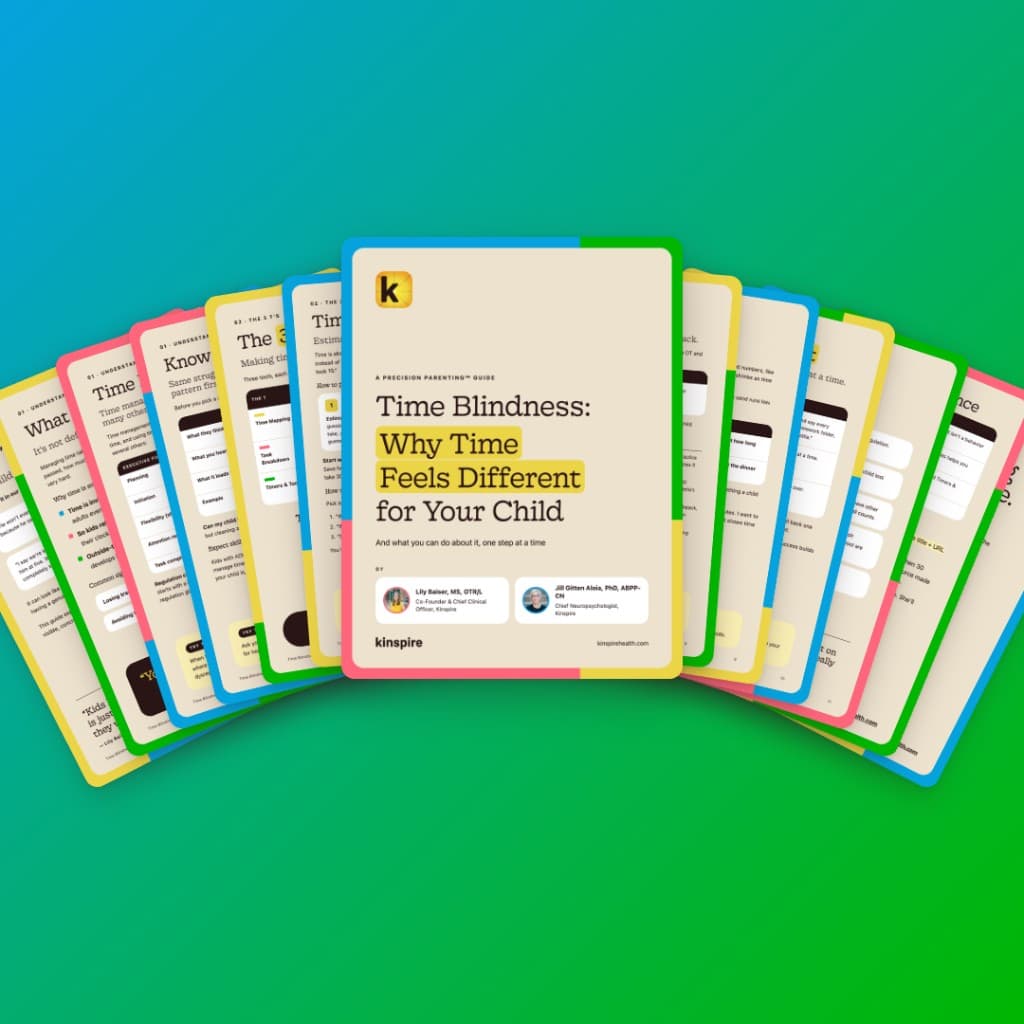
Download the Time Management Precision Parenting™ Guide below to put the 3 T's into practice this week.
Try this this week
Pick one T. Try it with one routine. Notice what happens. Start with the estimation game on something low-stress, like folding laundry or brushing teeth: everyone guesses, you time it, and compare. And expect good days and hard days. A rough morning doesn't mean your child lost their skills. It usually means regulation is off today.
Instead of asking:
“Why don't they care that we're late?”
Try:
“My child can't see time yet. How can I make it visible?”
Episode outline
- “My child has absolutely no concept of time”
- What is time blindness? Overestimators and underestimators
- Chronological age vs. developmental age: the 30% delay
- The executive functions behind time: planning, initiation, shifting
- Why regulation comes first
- The 10-minute warning, and why it surprises them every time
- Making time concrete: now and not now, visual timers, the estimation game
- Can my child be both an overestimator and an underestimator?
- Homework that “takes forever”: movement first, one problem at a time
- How to talk about it: three sentences at bedtime
- The teen who's late because the morning fills up
- The 3 T's: Time Mapping, Task Breakdown, Timers & Tools
- Scaffolding an eight-year-old's morning, from back-to-school to winter
- Take-home for the week: stay close, observe, and drop perfection
- What happens in a Kinspire group session
Mentioned in this episode
- Download the Time Management Precision Parenting™ Guide
- Episode 3 — Am I Going to Be Doing This Forever? (scaffolding)
- Episode 4 — After-School Meltdowns: Why Kids Fall Apart at Home (and What Helps)
- Precision Parenting™ on Kinspire
- Live group sessions with Kinspire experts
- Suggest a topic for the show
- Start your free Kinspire membership
About the hosts
Lily Baiser, MS, OTR/L is Kinspire's Co-Founder and Chief Clinical Officer — a pediatric occupational therapist with deep expertise in regulation and sensory processing. Jill Gitten Aloia, PhD, ABPP-CN is Kinspire's Chief Neuropsychologist, with decades of experience connecting behavior, executive function, and the developing brain. Jennifer Mingucci hosts Built For Your Family™.
Transcript
Full episode transcript.
Jennifer
Welcome to Built For Your Family™, an original podcast by Kinspire. I'm Jennifer Mingucci, and I have the privilege of leading our incredible community of parents raising outside-the-box kids. These are parents navigating developmental differences, delays, diagnoses like autism, ADHD, sensory processing challenges, learning differences, or sometimes just the feeling that traditional parenting advice doesn't quite fit their child. And if that's your story, you belong here with support built for your family.
Jennifer
We're hosting sessions with parents every single week at Kinspire, and again and again, we hear how much time management impacts daily life. We hear things like, "My child won't even start his homework because he says it's going to take hours." We hear things like, "My daughter is late for school at least three times a week because she tries to fit way too much into the morning." Or, "I tell him we're leaving in 10 minutes, I remind him we're leaving in five minutes, and somehow when it's actually time to leave, he is completely shocked." Or she says, "I only need five more minutes," and then 45 minutes later, we're still right here.
Jennifer
If any of that sounds familiar, today's episode is for you, because we're talking about something parents often describe as, "My child has absolutely no concept of time." But what does that actually mean? Is it poor planning, procrastination, not listening? Is your child just moving too slowly? Or is there something happening in the brain that makes experiencing and managing time genuinely harder? Today we're going to unpack time blindness, how time management connects to executive function, why two kids with the same time management struggle may need completely different support, and practical ways to make time more visible, concrete, and manageable for the child in front of you. Let's jump right in.
Jennifer
Dr. Jill, what could actually be happening inside for these kiddos, and what is time blindness?
Dr. Jill
When we think about time management, it's really helpful to think about it as an executive skill. It's not that they're ignoring time and ignoring you. It's not that they aren't interested in doing things on time. It's that they're really struggling with estimating time. And for kids and adults, it happens for all of us, it can go in one of two directions. There are underestimators and there are overestimators. So what's an underestimator?
Jennifer
That's me. An underestimator is me. I'm like, "We can record 12 podcasts today," because it's not going to take that long.
Dr. Jill
Exactly. It's that sense that things are going to take just a little bit of time, when actually they take much longer. As adults, we recognize this: "Let me just do these last three things before I leave the house." I was supposed to leave the house in five minutes, and I can throw in a load of laundry, do the dishes, clean up the living room. There are all these things we think we can do because we're underestimating how long they'll take, and that happens for lots of kids. Where that shows up for them is homework, for instance. If they're an underestimator, they might think, "That assignment's just going to take me 10 minutes," when actually they're supposed to be writing a paragraph and it's going to take a half hour or more. So they're underestimators, and they're getting in trouble because of that. On the other end, we have overestimators. Overestimators think things are going to take so long that they don't—
Jennifer
Forever.
Dr. Jill
Forever. That's how they feel. They truly feel that way, so they don't want to engage in tasks because they think they're going to take forever. That might be the math sheet that actually takes them 10 minutes, and they feel like, "Oh my gosh, this is going to take me an hour." It might be the chore you've asked them to do. I remember this with my own son: "I don't want to fold my laundry. That takes forever." We said, "All right, let's time it." It actually only took five minutes to fold those shorts and T-shirts. That can be mind-blowing for people. So, underestimate or overestimate, either way, their time estimation is off, and it really impacts their functioning.
Jennifer
I feel like we are so supportive of young kids with time. If you think about a kindergarten classroom, there's so much support built into the day to help kids with time. They use visual clocks, they use bells, they use songs. Then as the child gets older, all of those supports kind of disappear. Lily, you've talked in the past about chronological age versus developmental age. Could you talk about how that might show up with time for, say, a 12-year-old with ADHD? Really, what age are they?
Lily
When we think about a child who has ADHD, there's going to be a deficit and a delay. They say there's about a 30% delay in their skills. So if they're 12 years old, they really have executive functioning skills more like a nine-year-old. Twelve is such a hard age because they're in middle school, and we're throwing these 12-year-olds into middle school, which requires so much more executive functioning, while their skill level is more like a nine-year-old's. That's why we see so many challenges in that age group: there's a gap between what we expect of them and what their abilities actually are. So we have to look at our kids in a different way. Especially if they're neurodivergent, we can't always expect 12-year-old skills from a 12-year-old. We need to throw that concept away and say, "Okay, where is my child? What skills do they have?" and work with those skills, because they will improve as they get older, and those skills will mature. There's no benefit to anyone in expecting our 12-year-old with ADHD to have 12-year-old skills. We really just have to reframe that and understand where they're at.
Jennifer
I like that you brought up skills, plural. Dr. Jill, many parents are going to come into today's episode thinking we're only going to talk about time management, because that's the executive function delay that's causing the issues with time. You blow our minds by reminding us that many executive functions are at play. When we have a child dealing with lateness, or not starting a task because they think it's going to take forever, what are all the executive functions at play?
Dr. Jill
Executive functions are intricately linked to each other, so it's really hard to talk about just one at a time. A few that come to mind for time management are planning, attention, and initiation. Let's say you have to do that math worksheet. You have to plan what needs to happen to get it done. It's not like, poof, suddenly the worksheet is on the desk you're going to work at, you've got a pencil, and the television in the background has been turned off so you can focus. You actually have to plan out all of those steps, and each and every step takes some time estimation. We're doing this all day. We just don't bring it to our conscious mind. We're thinking, "I have to make dinner, and I have to find all the ingredients, and it takes 30 minutes to cook, but I'm going to add an extra 10 minutes to pull everything out, get the pots and pans, and maybe clear off the counter first if it wasn't clean from the last meal." We do this all the time, and we don't recognize that it's a skill we have to build in our kids. So one is planning. Another is initiation: can they just get started? Even if they have a somewhat accurate sense of time, can they initiate the task? And moving from one task to another is another executive function, shifting. All these different executive functions come into play when we think about time. Time doesn't exist by itself, and it needs a lot of scaffolding to help our outside-the-box kids get there.
Jennifer
And then Lily, how does your world play into time management? How do sensory and regulation potentially impact a child's ability to have that skill?
Lily
Typically, when a parent comes to us and says, "Their time management is so poor, we can never get out of the house on time," I actually say, "Tell me more about what's going on," because nine times out of 10, there are so many other executive functions at play, like Dr. Jill was saying. We have to break it down a lot more and understand where the actual breakdown in the routine is. Once we can identify that, we can put supports in. And as far as regulation goes: if your child is not regulated, they can't access any executive functioning. If you have a dysregulated child before the morning routine even starts, they wake up, they're already in a bad mood, they're already showing signs of dysregulation, all bets are off. I can guarantee the morning routine is going to go poorly. So we have to stop everything, put on our regulation glasses, and think, "How am I going to regulate my child?" before we can even ask them to use their executive functioning skills. We always have to make sure they're regulated first, and then we can ask them to access their skills in order to be successful.
Jennifer
As always, you and Dr. Jill go together like peanut butter and chocolate, because we can't even get to Dr. Jill's executive functioning skills if we're in a dysregulated state.
Lily
Right. It always starts there.
Jennifer
I want to give a parenting example that kept coming up. Let's all travel in our minds to the scene. The scene is: we are leaving in 10 minutes. I can go back to my childhood and hear my own mom giving the 10-minute warning. Parents give the 10-minute warning because our parents are all in. They come to sessions, they come to talks, they listen to this podcast. They know they can't give just one warning before a transition, so they say, "Okay, five minutes and then we're going to head out the door. Okay, two minutes. Now it's time to go." And their child looks at them like this is brand-new information. What does 10 minutes actually mean to a child who doesn't have a sense of time? Dr. Jill, what's the disconnect between me saying 10, five, two, and still getting the surprised look?
Dr. Jill
As you were saying that, my first thought was: you said 10 minutes, and they might be thinking, "Cool, I have time to watch this entire show," which is actually a 30-minute show. They don't have a sense of how long 10 minutes is. One simple thing a parent can do to start building this knowledge, and they're not going to get it overnight, is to say, "We're leaving in 10 minutes. That's usually how long it takes you to brush your teeth," something they're very familiar with and do all the time. If you start linking lengths of time to activities they do, that can be very helpful. It might be homework: "I think this homework will actually take about 30 minutes," when they're expecting it to take much longer. Well, what is 30 minutes? Thirty minutes is usually how long we sit at the dinner table. We eat, clear our plates, and we're done within 30 minutes. You're giving them a sense of what time is. That can be a first step toward understanding how much time is left when you say, "10 minutes," "five minutes," "one minute left."
Jennifer
Lily, I want your OT creativity brain to come online. My favorite thing OTs do is give us creative ideas, and one of the suggestions that came up was making time, which is abstract, concrete. What are some OT magic tools parents can consider to make something like 10 minutes actually concrete?
Lily
To help parents understand why it's so hard for kids, I always tell them: kids know now and not now, and that's it. So 10 minutes is just "not now," and they can fill in as much as they want into that not-now time. What Dr. Jill was saying about linking it to something they understand, so they can start building a sense of time, is really helpful. There are also timers. There's one called the Time Timer that gives a visual cue: there's color in the timer, and the color slowly disappears. That's a great tool. Also, help your child with a checklist. If a few things need to happen within a certain time, give them a checklist with the timer, so they can understand, "Okay, I have three things left and this much time left. I'm going to need to work on that." We also often talk about time estimation activities. You can actually turn this into a game: "How long do you think it's going to take to brush your teeth?" The kid might say, "That's probably going to take me 15 minutes." Or you have an underestimator and it's, "Five seconds." You write down everyone's guesses, and I'd make a guess too as the parent. Then we actually do the activity and time it, and go back to our guesses and compare. Like Dr. Jill said, it's mind-blowing to them. We've done this many times in our household. I have one overestimator and one underestimator, and it's such a helpful activity because it really puts things into perspective. Folding laundry is a big one in our house. I ask, "How long do you think it's going to take?" It always takes under five minutes, always, and everyone thinks it's going to take 30. So that's a fun one. I also think visual timers are good for everyone, even grown-ups who may struggle with time. Use your Alexa, use your Google Home, get all of that set up for yourself. It can actually help you too.
Jennifer
We can all benefit. Dr. Jill, someone in our community brought up something so related to what you're talking about: can my child be both at different times? They think homework is going to take forever, and they think it's only going to take them one minute to clean a playroom that looks like a bomb went off in it.
Dr. Jill
For sure. Can one child be both? Yes. Think about it as ourselves. Executive functions aren't one of my most difficult areas, and we all have our difficult areas, but there are things I overestimate and underestimate. It's funny that Lily brought up laundry, because even though I know it only takes a few minutes, in my head I may be thinking, "I don't want to do the laundry. It's going to take so long to fold." And then getting out of the house, I'm thinking, "I can do these five things before I leave," because I'm underestimating. So even as adults who have picked up executive functions, we still do this. Apply that to an outside-the-box kid who's really struggling with executive functions, and absolutely, they're going to struggle. That's why the time estimation task is one of the most effective. I've seen many kids practice this skill and then have it as an independent skill they use in high school or college or as they move into adulthood. It really does work. We've seen it in practice a ton. And like Lily said, you can start with time estimation for things that aren't such stressors. Homework is a big one: kids are often resistant to homework because they think it's going to take too long, or they don't put enough time in. So do it with something fun, like playing a game or eating dinner, things that aren't stressful, and they start to build this sense of time and see it as a skill they can build. The other thing I always say is that talking out loud is helpful. As a parent, I might say, "Okay, I've got to leave the house in five minutes, so I have three things I want to do. But no, those will probably take 15 minutes. Let me pick the one that's actually only going to take five." We're having these talks with ourselves anyway when we're getting ready to do tasks. If we speak them out loud, we're teaching our children that it's not that something is broken with them and they have another skill to practice. This is just part of everyday life. We pick up these skills, and we're helping our children pick them up too.
Jennifer
I want to go back to homework, because I can't explain the number of inquiries we get on this topic, and Lily, I know you deal with this in your own household. For the parents who submitted this issue, whose child won't do homework because they say it's going to take forever, how might we workshop the homework routine? Lily, where might you begin?
Lily
There's so much involved in homework. It's not just a time estimation problem. There's initiation too: it's overwhelming to see a whole paper in front of you. How do I get started? I don't know what to do. It's going to take forever. All of that comes into play, so homework really requires almost all of our executive functioning, and we have to help break it down for our kids. I'm going to say this again: we need to give them movement before we start homework. That is going to help so much, because if our bodies are dysregulated, we're not going to be able to access our skills. Before homework, even three to five minutes of movement helps. It can be as easy as, "Go run around the house and then tag me and tag Dad." You don't need any fancy equipment. It could be, "Let's throw the ball around outside for five minutes," or "Let's do 10 push-ups," if your kid likes push-ups. Then we can sit down. If your child is automatically resistant, that shows they're feeling overwhelmed and we need to break it down. If there are five questions in front of them, you can say, "Hey, we're just going to do one right now. Let's just try to get one." You can even cover the other ones with a piece of paper so they only see that one. You'll be trying different strategies and seeing how they respond to each, because we need to figure out where the breakdown is. If giving them that one problem helps them get started, the following problems are typically a lot easier. Very often, it's just initiation that's hard, because the whole task feels so overwhelming.
Jennifer
I wish I had a bell for every time you bring up another executive function. Initiation, ding, ding, ding. Dr. Jill, give us your how-to-say-it piece of this puzzle. If I'm going to talk to my child about homework because they say it's going to take forever, I know from you that I'm not going to have the conversation when we're starting homework, during that stressful time. But later, at bedtime, when we're chilling and he's in bed, what am I going to say to him about homework?
Dr. Jill
You can actually bring it up fairly directly: "We have something new we're going to try starting tomorrow." And this is where you want to be validating, because it's a real feeling your child has: "It feels like homework takes forever." Or, if your child is an underestimator, "It feels like you can get it done so quickly. But it'd be really helpful to know." So, three sentences: we're going to try something new, validate their feelings, and "We're going to make it a game. We're just going to time it. I'm going to make an estimate, you're going to make an estimate, and we'll see who's closer." That's it. You're not even making any changes at that point. You're just bringing time into their awareness. I think we worry as parents that if we don't get this homework thing figured out immediately, our kid isn't going to graduate from high school.
Jennifer
Oh, yes. We go right to, they're not going to get into college. They won't have a job.
Dr. Jill
It's the end of the world. We go right down that path. I've done it. We all do. We worry, "That's it, they're going to be living with me forever." But it's not true. The truth is, we know we can slowly build these skills. If they have a couple of missing assignments in elementary school, and you communicate with the teacher, "We're really working on time estimation so my child isn't so resistant to homework, and we might not complete every single assignment," you're letting them know you're working on the skill. It's usually okay. And slowly, you can build these various skills.
Jennifer
You're also reminding me that these conversations can just be direct. Sometimes we think we need the full fancy script, said just the right way, when we could just say, "Here's something we're going to try this week."
Dr. Jill
Yes. And that you're on their side: "It's not working, and I don't want you getting in trouble with your teacher, or me getting upset with you, so let's try this new thing, and we'll do it together." If you have a kid who enjoys games, you can add, "Are there a couple of things you want me to time?" It's not just about them and their homework. What should we estimate? How long it takes to cook dinner, how long it takes to drive to Target. They don't know that you have a sense of time about all these other things, so you can make it an estimation game in other places too.
Jennifer
I want to talk about the other end of the spectrum. A fellow community member has a daughter who, like me, is an underestimator, and this is about what the parent perceives as an utter lack of urgency. She wrote, "My daughter is late for school at least three times a week because she tries to do too much in the morning. She has 15 minutes before they need to leave, and suddenly she's looking for a specific sweatshirt, reorganizing her backpack, her Stanley cup needs to be rearranged and filled for the day, starting something new, or deciding now is the perfect time to find something she lost three days ago." I feel like I have a very good handle on the vibes of this morning. And the mom is saying, in all caps, "How do you not know we don't have time for this?" Dr. Jill, when it feels urgent, Mom's at the doorway holding her keys, and the daughter is saying, "Ooh, and I need to…," what's going on in her brain?
Dr. Jill
That's true time blindness. Time is not what she's paying attention to. In the field of attention, there's a word for this: saliency. What is most important to me right now? What's most important to her is that missing sweatshirt, or that Stanley cup that isn't filled up. What's not most important is the fact that time is dwindling away. So it's really about what she's paying attention to. A couple of creative ideas: they could time the morning at a different time. We've talked in other episodes about being creative about when you do things. You don't have to time your morning in the morning. You could do it on the weekend, in the middle of the afternoon: "Let's pretend we're going through our morning routine. How long does it actually take, and how much free time is there?" And especially since this sounds like an older kid, maybe a middle schooler or even a high schooler: do you want to build in extra time? "You've given yourself 30 minutes, and it actually takes you 29 and a half to get ready. There's no extra time. But I'm noticing that sometimes you want to find the sweatshirt, and sometimes you want to clean out the Stanley cup. Should we always build an extra seven minutes into your morning, so we move up the time you wake up?"
Jennifer
When I read her submission, I was like, "Girl, 15 minutes? What can we get done in that time?"
Dr. Jill
Exactly. So, build in extra time. Another thing to consider is doing things ahead of time. If she doesn't want to get up any earlier or add more time, what can you do the night before to set yourself up? Look at what happens in the morning and write down everything that needs to be done. Maybe you fill up your Stanley the night before and put it in the fridge, so it's nice and cold. Maybe you pick out your clothes. I know teenagers will change their mind in the morning—
Jennifer
We need the right sweatshirt. We need it.
Dr. Jill
Right. But at least you have a starting point. Can you pack your backpack? Can you do all these things the night before that will make your morning more successful? It's really thinking outside the box for outside-the-box kids.
Lily
If you have a child who struggles, who's slow in the morning and doesn't react to "Hurry up, we have to get out of the house," taking something completely off the plate, like getting dressed, can be really helpful. They get dressed the night before, sleep in those clothes, and then they're off to school in the morning.
Jennifer
I also appreciate flipping the problem-solving. Instead of only looking at everything happening in the morning, look at the routine before it. Look at the nighttime routine and what you're doing at night, because that can actually solve your problems in the morning. Sometimes we get so laser-focused on one specific routine that we don't think about expanding our creativity.
Jennifer
I want to talk about something that came up in our time management workshop: the three T's of time support. We love alliteration. We talked about time mapping, task breakdown, and timers and tools. Let's start with time mapping: estimate, do, reflect. Why is it useful to have a child predict how long something will take, actually do it, and then compare the prediction with reality? We talked about this a little earlier, but Dr. Jill, what are they actually learning from that process?
Dr. Jill
They're actually learning what time is. If we think about it, time is a completely abstract idea, with the exception of the sun moving across the sky. What is a minute? What's an hour? Time just passes without them having a concrete sense of what it is. So how do you make it concrete? By doing activities that show what time is. You do that time estimation, and they start to learn about themselves. Rather than being told all the time, "You're too slow. You're not getting this done quickly enough," they realize, "Oh, I thought that was going to take five minutes, and it actually took me 15. I thought that was going to take 10 minutes, and it actually took me 20." It's such a strong way to learn, when they experience time themselves and see whether their estimates are accurate.
Jennifer
Task breakdown is next, which I feel like is an OT's gift.
Lily
It is. That is what we as OTs do. It's at the core of what we do.
Jennifer
Tell us what task breakdown is and how a parent can think like an OT on this topic.
Lily
You really want to take a task and break down every little step. It's not "Grab your water bottle, get your backpack, and get your shoes on." It's: you have to get your folders and put them in your backpack. You have to locate your water bottle, then fill it, then put ice in it. It's truly every single step. You have to break things down, because that's actually where our kids get stuck. When we give them these higher-level tasks, they don't know how to move forward, because they're not as good at breaking tasks down. So we have to take a step back and look at the task. It's like the peanut butter and jelly exercise: if you just say, "Make a peanut butter and jelly sandwich," a lot of people won't know what to do. We need to look at the task and make sure we're identifying every single step. Then we can really understand how much time it truly takes.
Jennifer
And Dr. Jill, the last one was timers and tools, which you put together, and which we talked about a bit earlier: making the abstract concept of time more concrete. I'd love to hear some of your favorite tools and timers for our community to consider. What's a go-to you've found successful with your clients?
Dr. Jill
The one Lily talked about earlier is really important, because it's a visual timer, which is a little different from a countdown timer. With a countdown timer, you still have to have a good sense of numbers, which many of our younger kids especially don't. If you have two minutes left and you're counting down from 120 seconds, knowing how those numbers go can be hard. A visual timer is more like a circle that's getting filled in, and you have a sense of it getting closer and closer to the point where we're out of time. So remember that we're not just adding in what we might think of as an obvious tool, like a timer, but something that works for kids who don't have all those other school skills, like paying attention to numbers. Even an old-school sand timer can be really helpful, because you see the passage of time. We all feel it when the sand is getting to the end: "Oh, I've got to hurry up and finish this activity." That's what it does for a child. It really shows them the passage of time, and that helps build the skill.
Jennifer
Lastly, I feel like people are hearing about timers and tools and visual schedules and worrying that they're now overhelping. In Episode 3, we discussed scaffolding. So I'm going to give you a case, and maybe together you can workshop how we'd scaffold time management. Let's do an eight-year-old with ADHD who is chronically late. We're late to school, and the school is saying, "This is becoming a problem." So it's getting out the door in the morning, ADHD, eight years old, elementary school. What could this parent do, and what would scaffolding look like between now and, say, January? Right now we're still in back-to-school mode, getting used to things. How might we scaffold this, and then remove the supports as we get into winter? Lily, do you want to start?
Lily
At the beginning of the year, you're going to be doing a lot of the morning routine for your child. If you know they're not successful yet, you're packing their backpack, packing their lunch, filling up the water bottle, and making sure everything is right by the door so you can put it in the car together. As far as getting dressed, you're probably with them, holding their hand: "Let's get your clothes out." It's going to be a high level of support at the very beginning.
Jennifer
And that's okay because…
Lily
Because they're learning. This is how you teach them these skills. You really want a child to be successful. If you ask a child to do something and they fail over and over, what is that going to do for their self-esteem and their confidence? It's really going to tank it. So we want to make sure they're successful, and we don't want to put them in a dysregulated state either. Then we gradually pull the supports away when they're ready.
Jennifer
Dr. Jill, how would I know when to start backing it off, and what would that look like?
Dr. Jill
Part of it is really breaking down those activities, like Lily mentioned with packing a backpack. And I want to add a point: one thing that can be really helpful is to speak it out loud, so you're not just doing it for them. You're doing it, but you're saying, "Okay, I'm packing your backpack now. I'm making sure your homework folder's in there, putting your lunchbox in, and grabbing that water bottle." So in that very first step, where you're doing it, you're also starting to teach them by speaking it out loud. If you've broken it down to three or four activities, then comes the first layer of pulling back the scaffold. Picture the scaffold on the edge of a building, holding it up, and you're bringing it down just a little bit. What does that mean? Maybe you say to your child, "Every morning, I put the homework folder and one other thing in the backpack. What's that other thing?" And you see if they can come up with it. You're starting to build their memory of what goes in the backpack, and you're pulling back by just one item. If they can't remember it, if they can't consistently say, "Oh, my water bottle," then you go back up on the scaffold: "I need to keep repeating these things in the morning for them. They're not ready." It's your way of testing it out: are they ready to take on one of these tasks, or two, or do they still need my support?
Jennifer
For parents who've listened today and are thinking, "This is my child. My child is the 'this takes forever' kid," or, "My child thinks they have time to do A through Z in the next five minutes," and they want to start supporting this skill: Lily, what's one thing our community members can think about in the week ahead? What's their take-home assignment?
Lily
It's always hard for parents to know where to start with scaffolding. I think that's probably the biggest question we get. What I'd say is: be ready to support them. Be by their side as you start to figure this out, and observe what they're doing. If you notice a little bit of dysregulation or a little bit of struggle, that's when you can say, "I think they might need some support here." That gives you more information about where to start. The other piece is that there will be good days and bad days. Based on regulation and their ability to access their skills, things might look different, and that's to be expected. So don't think, "Oh my gosh, today he can't do anything. He lost all his skills." That's not true. He's just having a rough day with his regulation.
Jennifer
And Dr. Jill, what's your takeaway for us this week?
Dr. Jill
One of my takeaways is that we might be making this more challenging for many parents in our community. What I mean is that many parents themselves struggle with executive function, time management, and time estimation. While we're describing the ideal, like being by your child's side and working through these steps of scaffolding, we also recognize that it might be hard for you, and it might be hard because you have three other kids who need your attention at the same time. So my number one piece of advice is to not expect perfection. It's okay if it takes time for everyone to work on these skills. Maybe at first you can't be by your child's side, so you draw a little picture with stick figures showing a cup, a folder, and the sweatshirt that goes in the backpack, and you do your best to point it out to remind each of them: "Hey, did you all get your water bottles? Did you all get your homework folders?" It doesn't have to be perfect. We're giving you ideas of what to do, and pulling in these little pieces will help grow these skills over time.
Jennifer
I want to end today's episode by inviting our listeners to join us in one of the group session workshops we host at kinspirehealth.com. I'd love to hear from Lily and Dr. Jill, who are always on with me, about what these sessions are like for our community. Lily, what's the typical format? And then Dr. Jill, maybe you could tell us why people should consider coming and hanging out with us.
Lily
We have workshops where we spend about 30 minutes explaining a concept, and then we save the last 30 minutes to answer questions from our community. It's so wonderful, because we absolutely love answering questions, and everybody in the room can relate to them. It really builds an amazing community.
Jennifer
And Dr. Jill, what have you noticed about group sessions that's valuable for parents?
Dr. Jill
A couple of things are really valuable. One is that they're getting information. For parents for whom this is newer, they get to ask questions about their specific situation, and we can answer them in the moment. But one of the things I really love about these sessions is that many of these parents have been around the block. They have more than one kid, they've been working on this, they've worked with different professionals, and they really like being part of a community where they can get information but also give it. That's what I love most: when parents add their own creative solutions about what has worked for their family, which can then help others.
Jennifer
In the first 30 minutes, you're going to experience a topic that Lily and Jill have broken down specifically for you. Lily, when you're making the slides you'll walk through, how in-depth can parents expect it to be? You're really going to explain something to them.
Lily
We try to give you all the tools you need to truly understand a concept, and we also try to give you something to take home: an approach you can try and personalize to your child. We try to give strategies. We really want you to come out of the workshop feeling armed and ready to make a change at home and apply what you've learned.
Jennifer
And hopefully you'll also connect with other parents on similar journeys. Dr. Jill, describe what happens in the chat at a group session.
Dr. Jill
Sometimes it's so much fun. It really blows up, in a good way. Lily or I are giving a presentation, Jennifer is doing an amazing job of monitoring the chat, and we're happy to pause along the way to answer questions that come up and add ideas, with parents sharing their ideas too. It really builds a sense of community, which I think is one of the keys for parents to recognize that they're not alone in this. A big part of what parents feel is, "I'm the only one out there with a kid who's just like this." There are parenting books and parenting websites, and they feel like, "It doesn't apply to my kid or my home, because our family is outside the box," whether it's the parents, the kids, or multiple kids. Being in a community where other people have that same experience is really helpful.
Jennifer
And Lily, for community members who go live, they unmute and share with you. Can you describe that experience for folks who haven't joined us yet?
Lily
We actually learn about the child they're referring to, and we give very specific suggestions and advice for what they should be doing at home. We love hearing the details. It's my favorite part, because every kid is so different, and because we ask specific details about your family, we can give you real support.
Jennifer
Join us at kinspirehealth.com and tap on Group Sessions. You can see our schedule for the next four weeks, and there are tons of opportunities to join us live. You'll register, and you can pre-submit your questions about what you'd like the experts and panelists to cover on that topic. After the session, you'll get a video of the session and a copy of the slides Lily and Dr. Jill create. Plus, we always end up making a one-sheeter or resource live in the session with the community, so you leave, like Lily said, armed with so much value. We hope to see you, and if you need anything else in the meantime, you can find us next week right here on Built For Your Family™. If this episode has helped you, the best thing you can do is leave us a review. It helps other families find the show. And if you know a parent who needs to hear this, share this episode with them. Thank you again for tuning in to Built For Your Family™.
Built For Your Family™ is an educational podcast. The information and strategies shared here are for informational purposes only, and are not a substitute for individualized clinical care. Lily and Dr. Jill are licensed clinicians, but nothing in this podcast creates a clinical relationship or constitutes therapy, diagnosis, or medical advice. If your child needs direct medical support, we encourage you to work with a qualified professional in your area. Built For Your Family™ is a Kinspire original podcast hosted by Lily Baiser and Dr. Jill Gitten Aloia. Produced and edited by me, Jennifer Mingucci. New episodes drop every week. Find us wherever you listen to podcasts and visit us at kinspirehealth.com to learn more.