
What you'll learn
A Kinspire parent wrote in with the question a lot of families are living: how do you handle lying when you want your child to know you're on their side, and there also wasn't anyone else around to eat the cookie? This episode comes from that request, and from a parent workshop on why kids with ADHD lie.
- Why "I didn't do it" and "I already did it" are the two lies parents hear most
- Skill, slip, and story: the lie is the second problem
- How lagging-skill lying differs from intentional, planned lying
- The snowball: once they're stuck in the story, each new question makes it bigger
- Impulse control, initiation, time management, working memory, and emotion regulation behind the fib
- Why a child can answer a question they never actually heard
- Magical thinking at 4–7, homework and screen time at 8–12, and layered cover-ups in the teen years
- Why regulation has to come first, or the question you already know the answer to starts a snowball
- Five shifts: state the fact, stay curious, name it without shame, make the truth worth it, and solve the real problem
- When lying is a safety issue and it's time to get more support
Key concepts
Terms from this episode, explained simply.
The lie is the second problem
What you see is the story. Under it is a slip, the forgotten chore or the grabbed toy, and under that is a lagging skill. If you only punish the story, the skill gap stays, and the next slip is already on the way.
Skill, slip, story
Skill is the executive function still growing, like impulse control or working memory. Slip is the behavior: acting before thinking, forgetting, starting too late. Story is the lie that covers it, a fast exit from trouble, embarrassment, or a task that feels too big.
Lagging skill, not a plan
Intentional lying is rehearsed, used to gain something, and often comes with little distress afterward. Lagging-skill lying is impulsive, used to escape a feeling, and the story falls apart. They were not planning the lie an hour ago.
The snowball
"Oops, I lied. Now I'm stuck." Kids with ADHD often aren't thinking ahead, so the story grows with every new question. Stating what you already see, instead of cross-examining, stops the snowball.
They may not have heard you
A child can answer a question they never processed, then later insist you never told them. Inattention and working memory can make "You never told me" feel true to them.
Shame is the engine
Adults with ADHD often say they lied as kids because they felt bad that, once again, something wasn't done. The lie is frequently evidence they want to do better, not evidence they don't care.
Don't ask what you already know
"Did you brush your teeth?" when the brush is dry is a test, and a test invites a story. "I see your toothbrush is dry. Let's go brush together" states the fact and scaffolds the task.
Regulation first
If the tank is empty, impulse control and initiation are offline. Asking "Did you finish your homework?" in that moment walks you into a lying snowball. Regulate first. Come back to the task after.
Show notes
Episode notes & resources.
Episode 7 is for the parent staring at a dry toothbrush, an empty cookie jar, or a blank homework sheet, hearing "I didn't do it." Jennifer, Lily, and Dr. Jill trace the lie back to the skill underneath it, and walk through what to say instead.
You'll hear why the two most common lies are "I didn't do it" and "Yes, I already did," and how to tell a planned lie from an impulsive one. Dr. Jill lays out skill, slip, and story, then adds the snowball: the lie that grows because the child is stuck. Lily talks about her own daughter, from a confident "Of course I brushed my teeth" to "Actually, I didn't," once the real problem was initiation and impulsivity rather than dishonesty.
The episode moves through the Dynamic Dozen, the skills most likely to sit under a fib, and through ages: magical thinking at four to seven, homework, chores, siblings, hygiene, and screens at eight to twelve, and more layered cover-ups in the teen years, when friendship and independence raise the stakes. If your child is dysregulated, their thinking brain is offline. That is not the moment to prosecute.
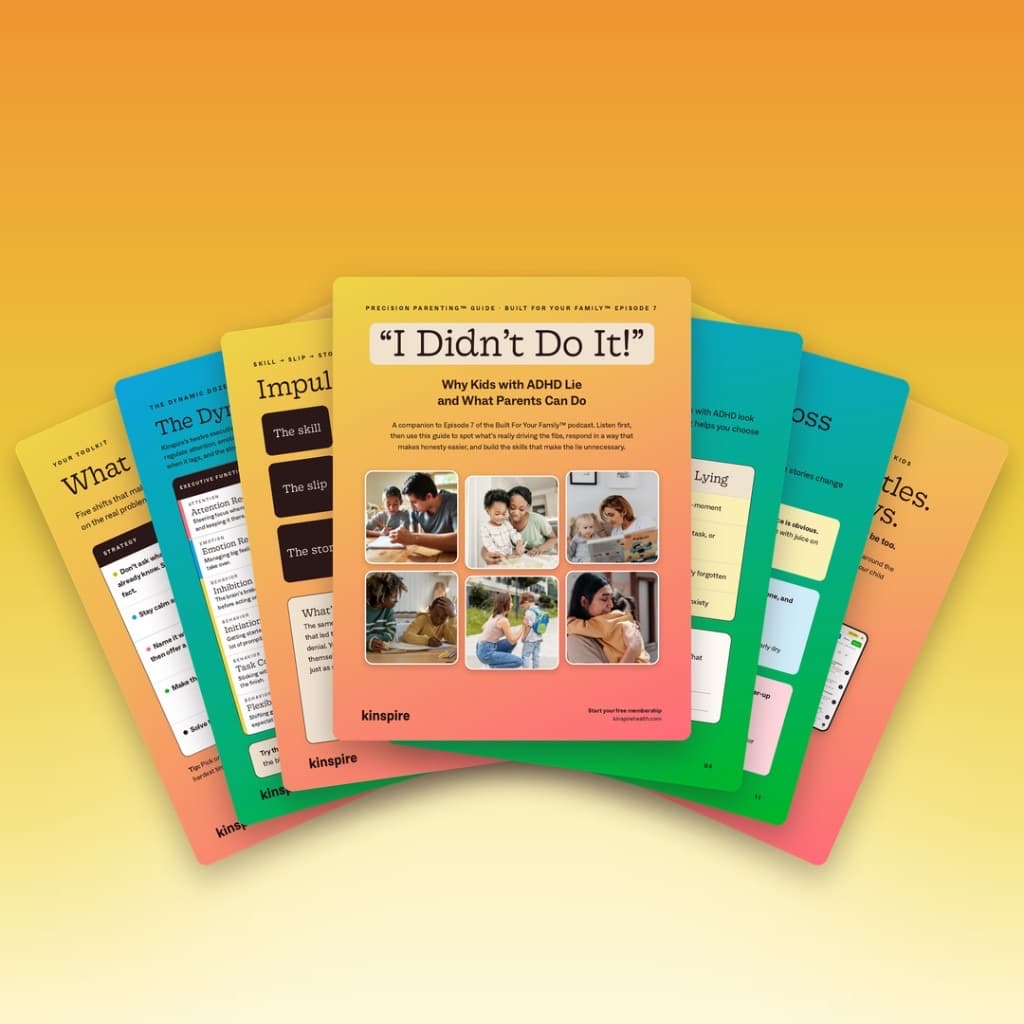
Download “I Didn't Do It!” below. It's the Precision Parenting™ guide from the workshop: how to tell lagging-skill lying from intentional lying, the Dynamic Dozen mapped to the slip and the story, what it looks like across ages, and five things to say instead.
Try this this week
Pick the lie you hear most. Before you ask a question you already know the answer to, state the fact and offer a way through. "I see your toothbrush is dry. Let's go brush together." "I see the homework sheet. What would help you get started?" If they're flooded, regulate first and come back. One phrase, practiced at the hardest time of day, is enough.
Instead of asking:
“Did you do it? I know you did.”
Try:
“I see what happened. Let's fix it together.”
Episode outline
- A parent writes in about the cookie jar
- Lily's daughter and the dry toothbrush
- The greatest hits: "I didn't do it" and "I already did"
- The lie is the second problem
- Skill, slip, and story
- Intentional lying vs. lagging-skill lying
- When they answer a question they never heard
- The Dynamic Dozen behind the fib
- The snowball
- Shame, and what adults with ADHD remember
- Ages 4–7: magical thinking
- Don't become the prosecutor
- Ages 8–12: homework, chores, screens, siblings
- Regulation glasses: skills go offline when the tank is empty
- Teens: the cover-up gets layered
- Stop asking questions you already know the answer to
- Five shifts, from stating the fact to solving the real problem
- When to get more support
- The one thing: slow down your own impulse
About the hosts
Lily Baiser, MS, OTR/L is Kinspire's Co-Founder and Chief Clinical Officer, a pediatric occupational therapist and a mom raising a daughter with ADHD. Jill Gitten Aloia, PhD, ABPP-CN is Kinspire's Chief Neuropsychologist, with deep expertise in ADHD and executive functioning. This episode grew out of a parent request and a Kinspire workshop on why kids with ADHD lie. Jennifer Mingucci hosts Built For Your Family™.
Transcript
Full episode transcript.
Jennifer
Welcome to Built For Your Family™, an original podcast by Kinspire. I'm Jennifer Mingucci, and I have the privilege of leading our incredible community of parents raising outside-the-box kids. These are parents navigating developmental differences, delays, diagnoses like autism, ADHD, sensory processing challenges, learning differences, or sometimes just the feeling that traditional parenting advice doesn't quite fit their child. And if that's your story, you belong here with support built for your family.
Jennifer
I always say, be in community with your community, and today's episode is a perfect example. It comes from a request we received from a longtime Kinspire member. You can email me too, at jennifer@kinspireapp.com. I read and respond to every one. If there's something Lily and Dr. Jill can break down for you, send it.
Jennifer
If you're new here, we host weekly group parenting sessions led by Lily and Dr. Jill. You can go live on Zoom with the people you hear on this podcast. We coach for about 30 minutes, then unmute parents for their specific scenario, so people leave seen, heard, and with a next step. You can join us at kinspirehealth.com.
Jennifer
Here's the request. "Thank you for hosting these workshops. I also wanted to see if I could drop in a request for how to handle lying. I know that lying is a developmental milestone, and that because of impulse control challenges, some of our outside-the-box kids might lie without even thinking it through. The lying puts me in a tricky situation. I want my kid to know that I'm always on their side and believe them, and there also wasn't anyone else around to eat the cookie."
Jennifer
Every parent can relate to that last line. You want to trust your child. You want them to feel safe telling you the truth. And you're standing there looking at an empty cookie jar, with no one else in the house. Today we're asking why an ADHD child lies, and how we respond in a way that builds honesty, trust, and accountability without the shame. Lily is an occupational therapist, and she's also a mom raising a daughter with ADHD. How has lying shown up in your home?
Lily
It's definitely shown up, and it's gotten a lot better over the years. The biggest one for us was brushing teeth. I would ask, "Did you brush your teeth?" A year ago it was always a very confident, "Of course I brushed my teeth. I did it." The toothbrush was dry. The toothpaste hadn't moved. We would just walk with her to the bathroom and say, "Okay, let's brush our teeth." Now if I ask, she'll say, "Yes, I did," and I'll say, "Are you sure?" And she goes, "Actually, I didn't," and she goes and brushes them. It's a knee-jerk response. Her brain fires it out, and now she can walk it back.
Jennifer
Dr. Jill, you talk with so many families raising kids with ADHD. What are the greatest hits?
Dr. Jill
"I didn't do it." It wasn't me. I didn't break it. I didn't take the cookie. I didn't hit my brother. That's the biggest one. Or the opposite: "Yes, I did that." Yes, I brushed my teeth. Yes, I turned in the homework. Yes, I finished it. One end is avoiding something they already did. The other is covering something they didn't mean to do.
Jennifer
In the workshop you said the lie is the second problem. Parents are going to hear that and say, what? You called the framework skill, slip, and story. Walk us through it.
Dr. Jill
The lie is the second problem because we want to understand the first one. The skill is the lagging skill behind the lie. For Lily's daughter, that was impulsivity: not being able to inhibit herself. That's the executive function we actually want to support. Then there's the slip. Oops, I said something impulsively. Oops, I hit my brother. Oops, I took the cookie. Oops, I forgot to turn in the homework. That's the problematic behavior. The story is the lie. The story is the last thing we see, and it's the thing we get upset about and want to consequence. But the skill is what we need to focus on.
Jennifer
That's the Precision Parenting™ way. We start with what we're seeing, then we dig back. Lily, does that match what you saw with your daughter?
Lily
A year ago the lagging skill was more about initiation. Brushing her teeth felt daunting, so she wouldn't start. That's evolved. It doesn't feel as big now, but the impulsive "yes, I did" is still there. She can recognize it and walk it back, which is huge.
Dr. Jill
You recognized that the skill was the issue, not the lying, and you helped her with initiation. If you only focus on the lie, you never address the real problem.
Jennifer
Parents are going to say, but this feels intentional. They do it so often. Pitch us on the mindset shift.
Dr. Jill
Intentional lying is planned and rehearsed. There's forethought: I want to gain something, I want to manipulate someone. And there's often not much distress afterward. Lagging-skill lying is different. It's impulsive. It happens in the moment, and the most important thing a parent can see is that the lie was used to escape an uncomfortable feeling. Shame. Worry about getting in trouble. Parents say, "It's intentional. They're avoiding getting in trouble." That avoidance came up in the moment. They were not sitting in their bedroom an hour ago planning, "The next time I'm about to get in trouble, I will lie." That's very different from a child who plans to steal something. That needs a different approach than the lagging skill we're talking about here.
Jennifer
Lily, if you could talk to yourself a year ago, what would you say?
Lily
Don't jump to the conclusion that they're intentionally lying. That's the first step. The next is figuring out the lagging skill, and scaffolding the task so they don't feel so overwhelmed. Give them the benefit of the doubt. I've also had so many moments where my daughter answered a question she didn't even hear. I thought it was done. I'd bring it back up, and she'd say, "What are you talking about? You never told me I needed to do that." And she was right. She wasn't processing what I was saying. Our kids can be talking and completely focused on something else, so they miss the moment. In the moment she knew to respond, but she didn't process the question. We have to consider that, and then figure out how to support them.
Dr. Jill
That's Precision Parenting™. Step back and look at the data. Is there a lagging skill? Are they being impulsive, or, as Lily said, inattentive? I put "just" in air quotes, because inattention is frustrating. But it feels different to say, "My child was inattentive and gave me an answer," than "They purposely tried to disrespect me." One pulls you forward: what do I need to do so they're paying attention? The other pushes you away.
Jennifer
If we can give the benefit of the doubt and go back to the lagging skill, what else is in that pool besides initiation?
Dr. Jill
I could walk through the whole Dynamic Dozen, but a few come up again and again. Impulse control: they hit a brother, took the last cookie, ate dessert before dinner. The slip is acting before thinking. The story is "I didn't do it," out as fast as the action was, because they're used to making this mistake and they're avoiding the consequence or the shame. Time management is huge for older kids. They didn't plan the homework or the project. "I told you I needed poster board," when they thought of it at the last minute, or they thought they told you because they said it in their head. The slip is underestimating the time, skipping steps, or not communicating the steps. Working memory: you send them upstairs for two things for the backpack and they come down with one. "I did it," or "You never told me," because they couldn't hold the information. The skill is working memory. The slip is they simply forget. And emotion regulation. ADHD is a disorder of regulation, not just attention. The slip is a big reaction: yelling, hitting, panic. The story is whatever they come up with to escape that feeling.
Jennifer
We'll link the Dynamic Dozen in the show notes, so you can map the skill, the slip, and the likely story.
Dr. Jill
Once parents can see the pattern, the lie doesn't feel so intentional, and it doesn't feel so painful. That's when we can step forward. There's one more S. Skill, slip, story, and then the snowball. "Oops, I lied. Now I'm stuck." Kids with ADHD often aren't thinking forward about where this is going, and they're impulsive, so the lie gets bigger when all it needed to be was "this is what happened." Parents are the key. If Lily questions her daughter — "Are you telling the truth? Are you lying?" — when she already knows the toothbrush is dry, the snowball grows. If she says, "Let's go brush your teeth. I notice the toothbrush is dry," the snowball stops.
Lily
Sometimes the snowball starts to feel like the truth. I've seen kids get really frustrated because they believe it.
Dr. Jill
There's research on our own memory, including eyewitness memory. If you tell yourself a story enough, it's hard to remember what was the story and what was the event. Kids can start to remember the lie. You can often see little blips where the pieces don't fit, because it wasn't a well-planned story. An intentional lie about the toothbrush would include wetting the brush and moving the toothpaste. An impulsive one doesn't fit the data.
Jennifer
Parents' feelings get hurt by the lies. Lily, how do you hold your child in positive regard when that happens?
Lily
I've gone through all of the emotions. I've landed on a lot of compassion, because I believe kids want to do well, follow directions, and be a good kid. They have roadblocks. Those lagging skills create the challenge. They don't want to lie. They don't want to upset you. They want to do the right thing, and sometimes they can't help it. I watch the impulsivity: "Yep, I already brushed my teeth," and two seconds later, "Well, actually, I didn't." Her brain just fires it out. That can't feel good to her. I remind myself not to take it personally, and to support her.
Dr. Jill
Adults with ADHD can speak to this better than almost anyone. They'll tell you, "I used to lie so much when I was a kid." That eases parents' minds: they are not still doing it all the time. It can still show up. I talked recently with a college student whose time management got her behind, and she told a professor she wasn't feeling well so she could skip class. More often, what I hear is the shame. "I lied because I knew I didn't get it done, and I felt so bad that once again I didn't finish my homework, or once again I ate the snack before dinner." Impulsivity is real. Shame is what I hear the most. "There's something wrong with me again. Someone's going to get mad at me again." So they come up with a story to escape that feeling.
Jennifer
Let's go age by age. Four to seven, you called it magical thinking.
Dr. Jill
Some of this is normal at a younger age. Something spills, it's right in front of you, no one else was there, and they say, "I didn't do it." It's as if they believe that if they say it, it can be true. We expect that to fade. Kids with ADHD are often delayed in these areas, so the magical thinking sticks around longer. The evidence is right there and they still say they didn't do it. I'd call it a reaction more than a thought: "If I say I didn't do it, because I feel bad that I did, then it will disappear."
Jennifer
I am a person who needs the record to be correct. I would become the prosecutor in Law & Order. "No, I know it's you," and I'd present the evidence. Walk me off the ledge.
Lily
You just can't do that. It will not end in a positive interaction. It turns into a battle and a power struggle, and it's not worth it. Shift the perspective. There is likely a lagging skill. Give them the benefit of the doubt.
Dr. Jill
They spill the drink and say, "I didn't do it." If you say, "I see that you did," you get "But I didn't," back and forth. If you say, "I see some spilled milk. Can you help me grab a towel? Let's clean it up together," you're done. They learn it's not a big deal to acknowledge the spill or to get the towel. They're not going to get in trouble. You're reinforcing that they don't need to lie. "Well, I see it" puts you in the snowball, and it reinforces the lying. It does the opposite of what you wanted.
Jennifer
If my reaction is huge, the message is, "If I actually said I spilled it, imagine what would happen." I'm teaching them what telling the truth will cost.
Jennifer
School age, about eight to twelve. You said these lies are often about homework, chores, siblings, hygiene, and screen time.
Dr. Jill
Poor time management: they didn't plan the homework. Or the tank is empty and they don't want to do it right then, so they say they don't have any, instead of feeling supported to refill first. Chores are the same. They're exhausted, or they can't transition off a game, so they say it's done. Or they thought about the chore, and in their head that became the chore being done. Siblings: taking a toy, wearing a shirt, hitting. Hygiene: they brushed their teeth, or they wet their hair and didn't use shampoo. Screen time: "I've only been on for four or five minutes," or "I haven't played yet today." Teens and college students still do versions of this. If you're hearing it, you're not alone.
Jennifer
When the tank is low, Lily, how does regulation connect to whether they can access these skills?
Lily
I have my regulation glasses on today. They're pink. Regulation is critical, because if a child isn't regulated, they cannot access their skills. Impulse control and initiation go offline. Everything goes offline. If they're heightened and saying something that isn't true, the thinking brain is offline. Focus on regulation first. You can come back to it once they're regulated, and almost give them a pass in that moment.
Dr. Jill
The emotional brain is firing. That is not the time to ask a question you already know the answer to. If you put on those regulation glasses and you can see they're worn out, not able to plan, initiate, or manage time, "Did you finish your homework?" is a setup. You know the chances are low. You're walking into a lying snowball.
Jennifer
For teens, the lies still come from executive dysfunction, but the cover-up gets layered.
Dr. Jill
Everything has a bigger valence in the teen years. They've been forgetting homework, hygiene, or chores for years, and getting negative feedback. By now they know that if they're honest about the homework, they might not get to go to the party on Friday, and what matters most is their friendships. They may care about grades and college, and they still can't resist the pull of the social, which is a normal part of adolescence and also that dopamine hit of what feels most important right now. They're pushing for independence. They don't want you in the portal. And the systems are messy. Even in middle school, one of my sons had to manage several different places where teachers posted homework. A disorganized kid might look in one or two places, miss two classes, and honestly think they did the homework for tomorrow, while you're asking about the missing work from last week. There's a mismatch between the question and the answer, on top of not wanting to get in trouble.
Jennifer
You asked parents, "When was the last time you asked a question you already knew the answer to?" Why should we stop?
Dr. Jill
We're worried about the future. Not just what happened, but "Are they going to become someone who lies and harms people?" So we try to catch them. "See? There's my evidence." Instead of staying in the present: the skill I need to build right now is initiation, or time management. Put on the regulation glasses, or the executive function glasses. What are they struggling with, and what can I help with in this moment?
Jennifer
There are five shifts. The first is don't ask what you already know. State the fact. Lily, if the toothbrush is dry, what do you say now?
Lily
"Let's go brush our teeth together," and I take her to the bathroom.
Jennifer
"Together" is the scaffold. It's a non-preferred task, and the language of the strategy is already the support.
Jennifer
The second is stay calm and curious.
Dr. Jill
If you can, "I'm not upset. Let's figure out what happened." Some parents can't say they're not upset, because they are, and they don't want to lie. Skip that part and stay with the curiosity. You saw the blank homework sheet. "I see the homework sheet. What can we do to help you get started? Do you need me to sit near you? Would you like a snack first? Do you want to do it in a different position?" Lily's daughter sometimes does homework upside down on the couch. "Can we make this fun?" Be curious about why the task didn't happen, not only about the lie. If they hit their brother: "What happened? What made you upset?" We're still going to say it's not okay. We also want to understand what led to the impulse. Curiosity glasses belong in the set, next to regulation glasses and executive function glasses.
Jennifer
The third is name it without shame, then offer a do-over.
Lily
A do-over gives them a chance to try again. There's so much shame under these behaviors. If you already know they're feeling shame, you don't keep poking. You know the lie happened. You know something didn't get done. Focus on getting it done. "This isn't done. Let's have another opportunity. Let's do a do-over and try again." No reprimand in that moment. See if they'll take it.
Dr. Jill
Naming it without shame helps the parent as much as the child. Parents feel, "Don't they need to know that I know they're lying?" You can let them know without calling it a lie. "The toothbrush was dry." "It seems like you were worried you'd get in trouble because you didn't do your homework." Then offer the do-over. That's how they start to feel they can get out of these situations without lying.
Jennifer
The fourth is make the truth worth it. "Thank you for telling me. That took courage, and it makes this easier to fix." If someone said that to me when I was in a pickle, my shoulders would drop.
Dr. Jill
It pulls you closer, instead of "I have to lie to get out of this." The message is, this isn't going to be that big a deal. We can fix it together. Next time, they might say, "I thought I did it all, but maybe I didn't. I'll go check," because the truth doesn't feel dangerous.
Lily
I've watched that change with my daughter over the past year. If she expected to be in trouble every time, she'd still be lying. It takes consistency, but we've made a space where she can make a mistake and try again, with more support. It really does change.
Jennifer
She wants to do well so badly. The story that they're doing this on purpose is so far from that.
Dr. Jill
The lying is often evidence that they want to be better. That they feel bad. That they recognize the weakness.
Lily
That's why so many kids are misunderstood. They want to do well, and they keep hitting a wall, because no one gives them a way to do better. They're yelled at. They're punished. Negativity on top of negativity. If we flip it and ask what the lagging skill is, we see a shift.
Jennifer
The last strategy is solve the first problem. People will think the problem is the lying.
Dr. Jill
The first problem is the lagging skill. Maybe we shouldn't even call it the first problem. It's the real problem. The lie is frustrating, and it feels personal. For kids with ADHD, the way through is to look at what's actually going wrong. A plan so homework doesn't pile up. Don't leave the cookies out if they're hard to resist. Check the playroom more often if siblings hit each other impulsively. Otherwise the child is stuck struggling, and they lie impulsively, or to escape the feeling, or because of shame.
Jennifer
From an OT perspective, the goal isn't to stop all lies. The lagging skill becomes the goal.
Lily
We address the skills: the executive dysfunction, the emotional regulation. That's what decreases the lying, because they're not so overwhelmed in the moment.
Jennifer
When is lying more than a lagging skill, and it's time to get more support?
Dr. Jill
I don't want to say every lie is only a skill gap. If teenagers are lying about safety, substance use, risky or sexual behavior, driving, speeding, tickets, that needs bigger support. Impulsivity can still be underneath, and you still want to address what's behind it. The flags I watch for are lying that is consistent and constant, planned in advance rather than impulsive, and especially lying used to hurt other people. Not "I hit my sibling and then I lied about it." A plan to steal from people, or some other planful, hurtful behavior. That's when to seek more support.
Jennifer
Where do families go?
Dr. Jill
A psychologist can help sort out what's leading to lying at that level.
Jennifer
One thing to take home. For me, it's that shaming in the moment can feel effective and is not the long-term solution. Lily describing her daughter changed how I hear this. They are trying to meet the expectation. Jill, what's the one thing you want parents to consider the next time they meet a lie?
Dr. Jill
Your own impulsivity about the lie. That reaction is automatic. We're not thinking about the big picture. We get upset with our kids for being impulsive, and then they lie and we impulsively say, "That's not true. I saw the dry toothbrush. I checked the portal." Can we slow down? Slowing down is what lets us see the lagging skill behind the lie.
Lily
This will not be forever. If your child is lying now, it does not mean they will be a liar for the rest of their life. And build some compassion. They want to be good, and they want to please you. If you have that, you'll look at the situation differently and figure out how to support them.
Jennifer
Lily and Jill, thank you. I hope this reminds parents that a child isn't defined by a lie or a mistake. Sometimes what looks like dishonesty is a child reaching for the fastest way out of a situation they don't yet have the skills to manage. Our job isn't to catch the lie. It's to help them develop a better way. If there's a parenting challenge you want us to tackle, send it. If this episode helped you, a review helps other families find the show, and if you know a parent who needs this, share it with them. Built For Your Family™ is an educational podcast. The information here is for informational purposes only and is not a substitute for individualized clinical care. Nothing in this podcast creates a clinical relationship or constitutes therapy, diagnosis, or medical advice. If your child needs direct medical support, work with a qualified professional in your area. Built For Your Family™ is a Kinspire original, hosted by Lily Baiser and Dr. Jill Gitten Aloia, produced and edited by Jennifer Mingucci. New episodes drop every week. Find us wherever you listen, and visit kinspirehealth.com.