
Big feelings · Transitions
Picture the moment it’s time to stop. Now picture it going differently.
You’ve tried the five-minute warnings, the timers and the countdowns. Kinspire helps you see why switching is so hard for your child, and gives you a plan made for them.
Sound familiar?
If this is your house, you’re not alone.
- Leaving the house
Shoes on, coat on, and the whole morning stalls at the front door.
- Screens off
“Five more minutes” turns into tears, every single time.
- Plans change
The playdate is cancelled, and the rest of the day goes with it.
of parents tell us executive functioning, like stopping and switching, is a challenge for their child.From the Kinspire State of Parenting report.
It isn’t defiance, and it isn’t bad parenting. Switching is a skill, and you can help it grow.
01We put parents at the center of care
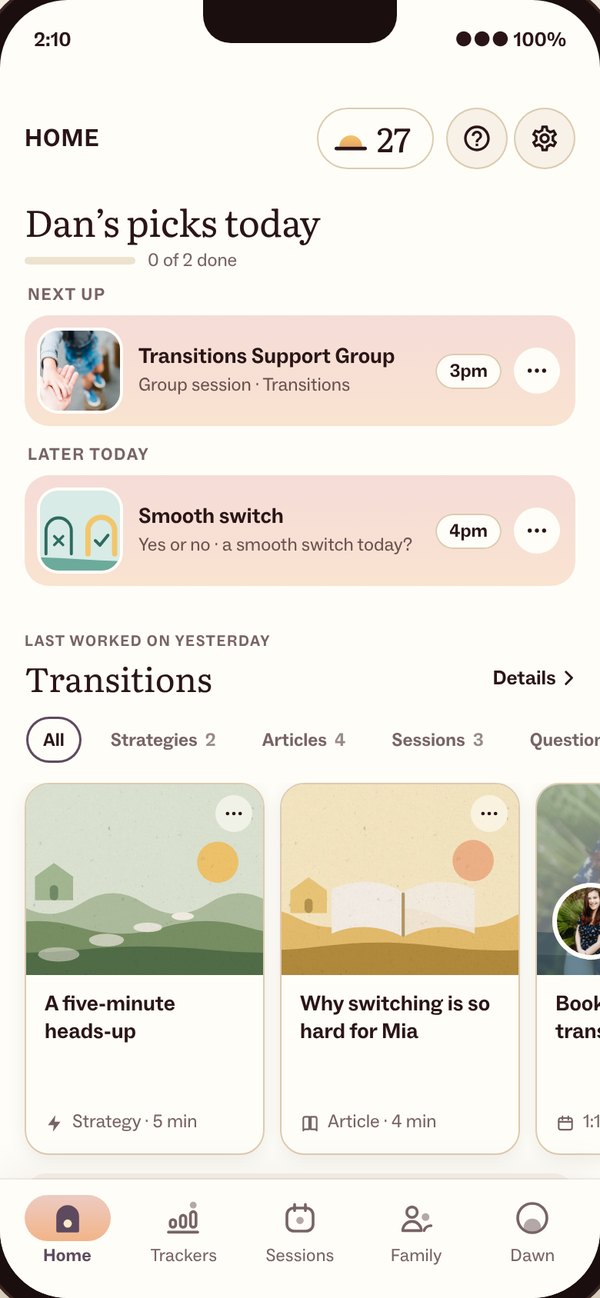
Transitions happen at home. So does the fix.
If your child sees a therapist once a week, that’s one hour. The hard switches happen in the other 167: out the door, off the tablet, into the bath, with you. Kinspire puts your plan for transitions right on your Home screen, ready for those exact moments.
- 7:40amOut the door
- 8:15amDrop-off
- 3:15pmPickup
- 5:30pmScreens off for dinner
- 7:00pmInto the bath
- 8:00pmLights out
Most hard transitions happen when something fun has to end.

02We keep real people in your corner
Some transitions need a real person.
When every switch is a battle, it helps to talk it through. Kinspire puts developmental experts and parents who get it in your corner, live, every week.
Live group sessions
 Workshop“But You Said…”: Why Your Child Falls Apart When Plans ChangeWhy a change of plan can feel like the floor dropping out
 Office HoursHow to Make Transitions FunGames and little rituals that turn “time to go” into something kids want to do
 Support GroupTimers and Tools: Parent PicksParents share the timers, charts and tricks that actually worked
1:1 sessions
Go deep with your own expert.
45 minutes on video with a Kinspire expert matched to transitions and your child’s age. They read your Family Profile before you meet.
Book a 1:1 Celina AndrewsMS, OTR/LRoutines and transitions
 Julia ColtonMS, OTR/LRegulation and stopping and starting
03We build every plan from scratch
No two hard transitions have the same cause.
Generic advice is why the timer didn’t work. Your Family Profile captures what’s really behind your child’s hard switches, across three parts of your life.
- Your child
What makes switching hard, and what helps
How they’re wired
- How hard it is to stop something they love
- Whether surprises or changes in plan set them off
- How they handle being rushed
- What helps them move on, like a job or a heads-up
- You
What you bring to the moment
Your energy and hard moments
- How rushed you are at the hard switches
- What you say when it’s time to go
- What you’ve already tried
- Your home
Where and when it happens
Routines, school and places
- The switches that go wrong most
- What comes right before, like screens or play
- How predictable each day is
Put together, they show why switching is hard for your child, not just when.
04We ground everything in clinical science
Two lenses on every hard switch.
Most transition advice is trial and error. Precision Parenting™ looks at what’s happening in your child’s body and brain, so you know why switching is hard and what will help.
Occupational therapy
Is their body ready to move on? Coming off something calming or exciting means changing gears, and some nervous systems need more time.
Neuropsychology
Is a skill still growing? Stopping, shifting attention and coping with surprises are executive skills that develop at different speeds.
AI
Puts both together for your child, and turns them into what to try first.

05We protect your family’s story
What you share stays yours.
Private to your family
Your account and your Family Profile are only for your family.
We never sell your data
Not to advertisers, not to anyone.
Your child’s name is protected
We remove details like your child’s name before anything is sent to our AI partners.
Progress, not perfection
More good days, one small step at a time.
- Try one thing todayA five-minute heads-upBefore screens go off.
- Reflect tonightHow did today go?A rating and a line about the hard switch.
- Wake up to what’s nextDawn adjusts the plan“Keep the heads-up. Add a job for the next thing.”
Also in big feelings
Related battles.
Questions
About transitions.
Why are transitions so hard for my child?
Stopping one thing and starting another takes skills like shifting attention and handling surprises. For many kids, especially those with ADHD, autism or anxiety, those skills are still growing.
Does my child need a diagnosis?
No. Kinspire is built for outside-the-box kids, with or without a diagnosis.
Do timers and countdowns work?
For some kids. For others they add pressure. Dawn helps you find what fits your child.
Is this therapy?
No. Kinspire is parent coaching and education, not diagnosis or treatment, and it doesn’t replace licensed care.
Fewer hard switches. More good days.
Start free with a consultation and your first plan.